Topics > County Durham > Allensford > Allensford blast furnace
Allensford blast furnace
Scheduled Monument area - based on Historic England data (Open Government Licence).
The remains of a late 17th or early 18th century blast furnace are located in the woods by the north bank of the River Derwent at Allensford. A forge in Allensford was documented in 1670 for the making and working of iron, and traditionally associated with the Shotley Bridge sword makers. An excavation of the site by Newcastle University in 1977 verified the remains of the blast furnace, which was almost certainly charcoal fired with water-powered blowing. It was in use until the early 18th century. The site included a bank of calciners (high-temperature furnaces used to purify metals), only one of which survives, and is similar in structure to late 17th/early 18th century lime kilns. The remains of the blast furnace are Grade II listed on the National Heritage List for England and the wider site is a Scheduled Monument (legally protected).
NHLE listing (#1045303): Allensford Blast Furnace, on N. Bank of R. Derwent 250 Metres East of Bridge
Click the headings below to expand (selected extracts from the Historic England listing)
Important industrial monument, traditionally associated with the Shotley Bridge sword makers.
Remains of Blast Furnace, late C17 or early C18. Furnace neatly- squared stone, calciner coursed stone. Furnace is ruinous square structure with jambs and part of round arch; walls with temporary protective concrete capping at time of survey. Calciner, further up bank, has splayed wing walls flanking round-headed arch into circular kiln; kiln wall standing 3 metres high in parts.
Important industrial monument, traditionally associatedwith the Shotley Bridge sword makers. Last use of the charcoal-fired blast furnance gave archaeomagnetic date 1740-10. Excavations 1977/8 by Newcastle University.
A 17th century blast furnace at Allensford, Northumberland', Lindsley, S.M and Heatherington, R. Journal of the Historic Metallurgy Society Xll no. 1 (1978), 1-11.

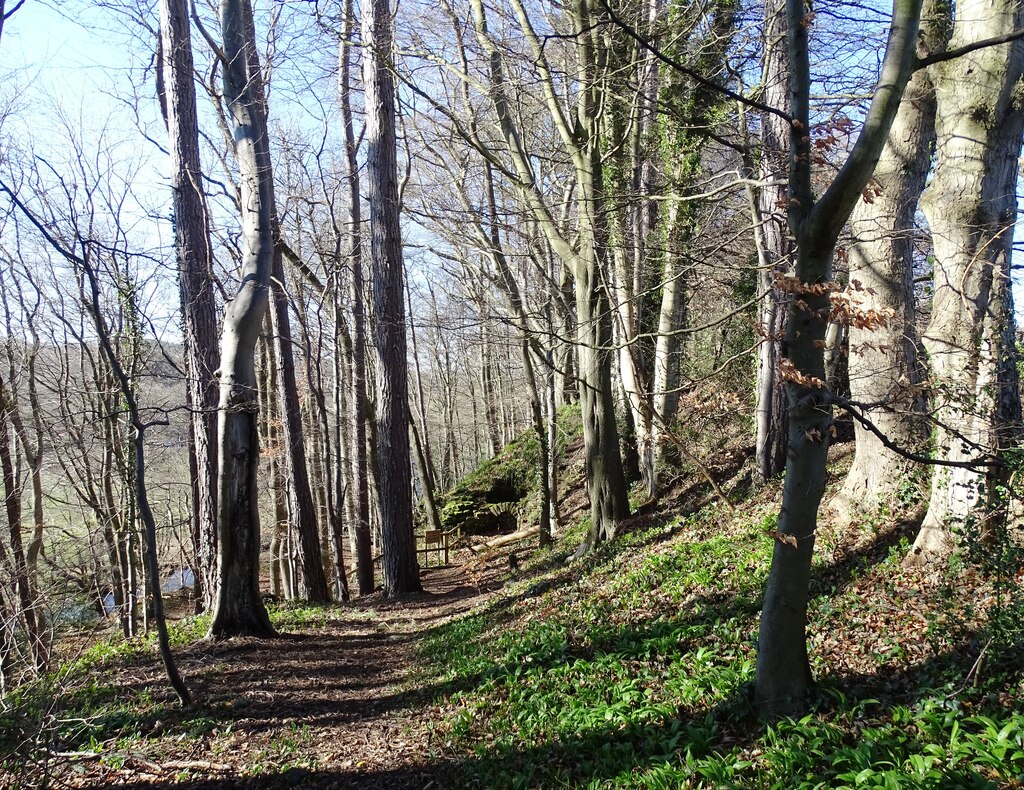
from https://www.geograph.org.uk/p…
Path to old iron furnace at Allensford
- The remains of an old blast furnace can be seen at the end of the path here, built against the hillside. It was built on this site beside the River …
Added by
Simon Cotterill
from https://historicengland.org.u…
Allensford Blast Furnace, on N. Bank of R. Derwent 250 Metres East of Bridge - List Entry
- Remains of Blast Furnace, late C17 or early C18. Furnace neatly- squared stone, calciner coursed stone. Furnace is ruinous square structure with jambs and part of round arch; walls with …
Added by
Simon Cotterill
from https://keystothepast.info/se…
Allensford Blast Furnace (Shotley Low Quarter)
- .....That a forge existed in Allensford in 1670 for the making and working of iron is clear from documentary evidence. That it existed until around 1730 seems clear although its …
Added by
Simon Cotterill

from https://www.geograph.org.uk/p…
Path to old iron furnace at Allensford
- The remains of an old blast furnace can be seen at the end of the path here, built against the hillside. It was built on this site beside the River …
Added by
Simon Cotterill
from https://historicengland.org.u…
Allensford Blast Furnace, on N. Bank of R. Derwent 250 Metres East of Bridge - List Entry
- Remains of Blast Furnace, late C17 or early C18. Furnace neatly- squared stone, calciner coursed stone. Furnace is ruinous square structure with jambs and part of round arch; walls with …
Added by
Simon Cotterill
from https://keystothepast.info/se…
Allensford Blast Furnace (Shotley Low Quarter)
- .....That a forge existed in Allensford in 1670 for the making and working of iron is clear from documentary evidence. That it existed until around 1730 seems clear although its …
Added by
Simon Cotterill