Topics > Tyne and Wear > Gateshead > Winlaton Mill > Winlaton Mill ironworks (1691 - 1863)
Winlaton Mill ironworks (1691 - 1863)
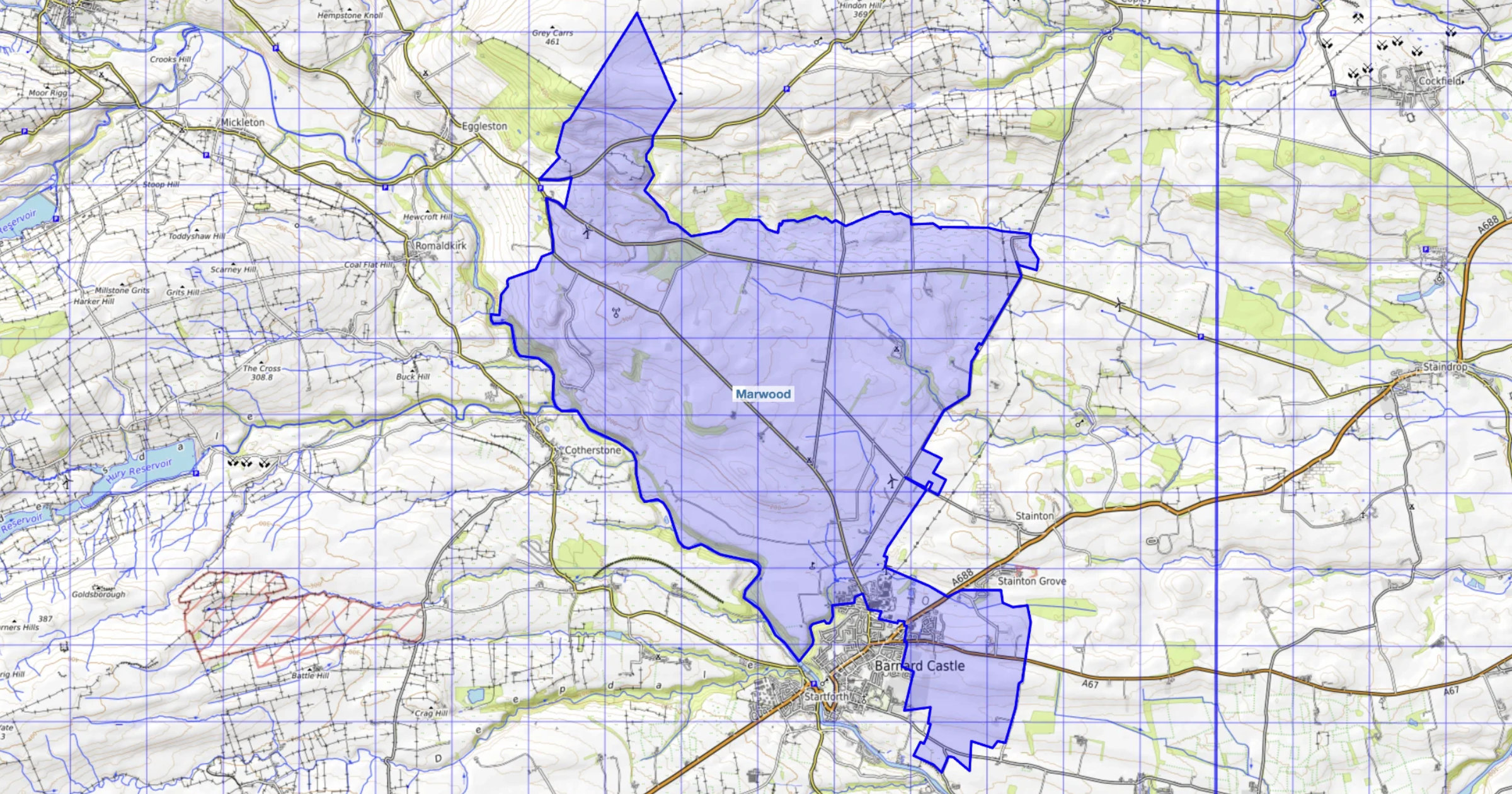
Scheduled Monument area - based on Historic England data (Open Government Licence).
Scheduled Monument (#1017224): Winlaton Mill ironworks, south east of Winlaton Mill village
Click the headings below to expand (selected extracts from the Historic England scheduling)
Winlaton Mill was a large integrated ironworks, forming a precursor of the Industrial Revolution. Archaeological recording in the 1990s has demonstrated good sub-surface preservation, and evidence relating to an exceptional range of processes will be preserved.
The importance of the site is enhanced by the survival of very extensive documentation. The dam also retains an important 'horizontal-arch' weir.
The monument includes the extensive structural, earthwork and stratigraphic remains of the Winlaton Mill ironworks and its associated water supply and housing. It is situated alongside the River Derwent, which provided an abundant power supply for the range of works at the site. The sites of the earlier corn and fulling mills are also included.
Development at the ironworks commenced in 1691 when Ambrose Crowley II, the leading supplier of ironwork to the Royal Navy, took over a pre-existing corn and fulling mill. The mill works were rapidly expanded into a major integrated ironworks, including a finery/chafery forge, plating forge, slitting mill, cementation steel furnace, blade-grinding mills, anvil shop, hardening shop and nailmakers' and filemakers' workshops, together with warehouses, offices and housing. The main water-powered mills and forges were located at the north east end of the complex, with the nailmakers' workshops, warehouses and offices around two squares to the west, and the housing along the base of the hillside to the west and south of the squares.
The south west part of the site was occupied by successive leats to the millponds, fed by a large multi-phase dam and weir on the River Derwent. The river weir allowed water to be drawn off the river towards the dam complex, where it could be routed according to needs. The dam complex is known to have had at least three phases, with the latest of these incorporating an early and unusual `horizontal arch' design with a curved weir and spillway, the latter angled against the current and supplying water to the southern millpond. A stone-lined leat 3.6m wide carried water from the dam complex to the northern pool (Great Pool) that served the ironworks. This leat had at least two phases of construction and examination suggests that the silting deposits surviving at the base of the leat will hold important archaeological and environmental evidence. The larger millpond occupied much of the central part of the site, and the smaller, square millpond to the south (located just south west of a modern footbridge) served a blade mill on the site of the earlier corn and fulling mills.
The ironworks saw only limited further development from the 1720s, and began to run down after the 1780s, when the Crowley family involvement ended. It finally closed in 1863. In the mid-20th century, much of the site was progressively buried by waste from a nearby cokeworks. This was removed under archaeological supervision in 1991-2, and the well-preserved remains were reburied and the area landscaped.
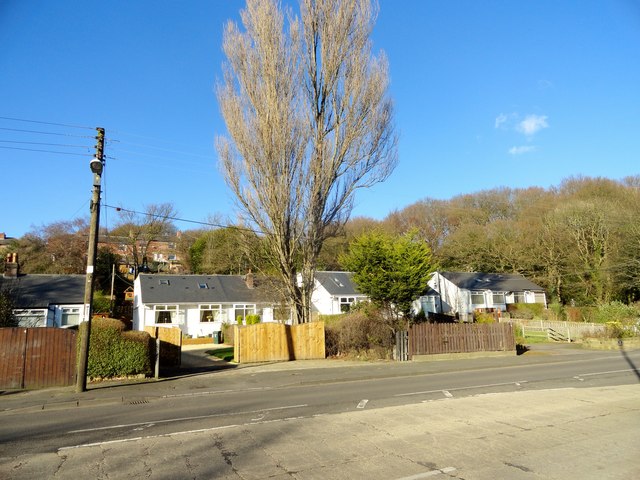
The main visible features of the ironworks are therefore the remains of the dam at the south west end, and ruins and earthworks of the workers' housing along the west side. The remainder of the works site is landscaped as a public park, but the below-ground structures and deposits of the ironworks survive beneath this.
Winlaton Mill is exceptional for a number of reasons. The Crowleys were a leading family of ironmasters from the Midlands, who acquired the Winlaton site because of its potential for integrated works on a massive scale. They brought with them much of the cumulative knowledge of the Midlands ironmasters, but also supplemented this with their own innovative ideas on iron manufacture. The works is also an important early example of the factory system of production, with the site integrating iron making, manufacturing, offices, storage and housing. The area of the monument includes the entire complex, where archaeological work has confirmed the presence of extensive stratigraphic and structural remains that can provide a wealth of further detail about the site. The site also has important documentary evidence surviving, particularly a map of 1718, which records the layout and function of each of the structures at the site. The works is also famous for the set of laws that Crowley introduced, to cover the workers' daily lives and to ensure the smooth running of production. The social welfare elements of this system were in place at Winlaton some two centuries before such things were available nationally.


Co-Curate Page
Ambrose Crowley (1658 - 1713)
- Overview About Ambrose Crowley Ambrose Crowley was important in the Iron industry. He founded the Crowley Iron Works at Winlaton, Winlaton Mill, and at Swalwell, in County Durham (now Gateshead). …
from https://historicengland.org.u…
Winlaton Mill ironworks, south east of Winlaton Mill village - Scheduling
- Iron has been produced in England from at least 500 BC. The iron industry, spurred on by a succession of technological developments, has played a major part in the history …
Added by
Simon Cotterill
from http://www.twsitelines.info/S…
Tyne and Wear HER(1006): Winlaton Mill, Crowley Iron Works
- "Ironworks founded in 1691 by Ambrose Crowley. The large majority of the complex was erected between the late 1690s and 1718, with limited later additions and alterations. It consisted of …
Added by
Simon Cotterill

Co-Curate Page
Ambrose Crowley (1658 - 1713)
- Overview About Ambrose Crowley Ambrose Crowley was important in the Iron industry. He founded the Crowley Iron Works at Winlaton, Winlaton Mill, and at Swalwell, in County Durham (now Gateshead). …
from https://historicengland.org.u…
Winlaton Mill ironworks, south east of Winlaton Mill village - Scheduling
- Iron has been produced in England from at least 500 BC. The iron industry, spurred on by a succession of technological developments, has played a major part in the history …
Added by
Simon Cotterill
from http://www.twsitelines.info/S…
Tyne and Wear HER(1006): Winlaton Mill, Crowley Iron Works
- "Ironworks founded in 1691 by Ambrose Crowley. The large majority of the complex was erected between the late 1690s and 1718, with limited later additions and alterations. It consisted of …
Added by
Simon Cotterill