Topics > Cumbria > Rivers in Cumbria > River Esk ('the Border Esk') > River Lyne (Cumbria) > White Lyne > Medieval Shielings by the White Lyne > Ten medieval shielings on north bank of White Lyne overlooking confluence with Little Hare Grain
Ten medieval shielings on north bank of White Lyne overlooking confluence with Little Hare Grain
Scheduled Monument (#1016404): Ten medieval shielings on north bank of White Lyne overlooking confluence with Little Hare Grain
Click the headings below to expand (selected extracts from the Historic England scheduling)
The ten medieval shielings on the north bank of the White Lyne overlooking its confluence with Little Hare Grain survive reasonably well and are part of a larger group of shielings sited amongst the uplands and along the river valleys and tributaries of north east Cumbria which, taken together, will add to our knowledge and understanding of the wider border settlement and economy during the medieval period. Additionally this group of shielings is a rare example of different types of shielings occupying the same site, and as such will facilitate any further study of the developments in the construction of shielings throughout the medieval period.
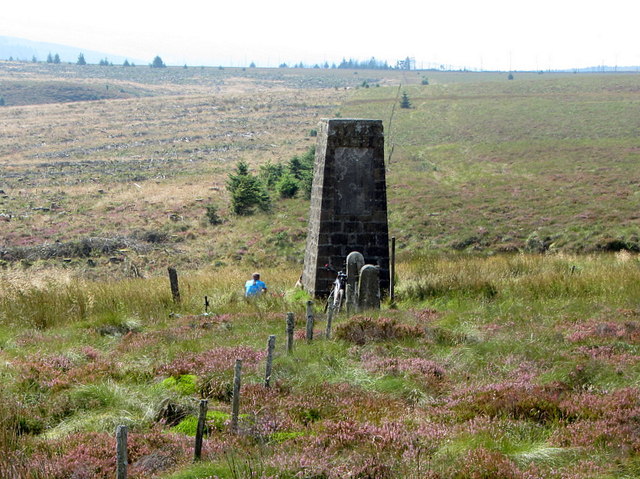
The monument includes the upstanding and buried remains of a group of ten closely spaced stone built medieval shielings which are located on an area of boulder strewn flat ground on the north bank of the White Lyne overlooking its confluence with Little Hare Grain. This group forms part of a larger group of 24 shielings strung out for approximately 800m along the valley floor of the White Lyne which were surveyed by the Royal Commission on the Historical Monuments of England in 1970 prior to afforestation of the area.
The most prominent and best preserved shieling in this group of ten measures 8.5m by 4.1m with its long axis aligned east-west and walls up of 1.75 high. It is divided into two unequal-sized rooms; the main entrance is at the shieling's north west corner and leads into the larger room which is paved at the entrance. The smaller room has a raised flagged floor, is entered through a doorway from the larger room, and was lit by a small window in the south wall. A low fibrous mound outside the hut to the south east and along the south wall is a fallen remnant of the turf roof. This shieling and a rectangular enclosure on its north side, the north wall of the former being common to both, have latterly been used as a sheepfold. The enclosure stands on the boulder footings of an earlier shieling which measured 8.4m by 4.1m with its long axis aligned east-west, and which was robbed to build the later shieling.
Approximately 14m ENE of the well preserved shieling are the boulder footings of a rectangular shieling measuring 9m by 4m with its long axis aligned east- west and an entrance in its north side to the west of centre. Some 14.5m south east of the well preserved shieling, at the edge of a low natural ridge, are the boulder footings of a rectangular shieling measuring 8.2m by 4.6m with its long axis aligned north east-south west and an entrance in its south east side to the west of centre.
Approximately 25m south east of the well preserved shieling are the large boulder footings of a rectangular two roomed shieling measuring 9.8m by 4.5m with its long axis aligned east-west and an entrance on the northern side. Ten metres to the south of the well preserved shieling are the boulder footings of a one roomed small squarish shieling measuring 6.1m by 5.5m with walls up to 1.5m thick and an entrance at the south west corner.
Approximately 23m south of the well preserved shieling are the heather covered footings of an almost circular one roomed shieling measuring 5.5m by 5.2m with an entrance on the south west side. Immediately to the west of this shieling are the heather covered remains of the northern half of a one roomed shieling measuring 4.6m wide with walls 1.1m wide formed of a boulder outer face, upright slabs to the inner face and rubble infill. Some 24m ESE of the well preserved shieling are the heather covered footings of a rectangular shieling measuring 9.4m by 4.7m with its long axis aligned east-west and an entrance in the south side west of centre. Approximately 66m ESE of the well preserved shieling are the boulder walls of a one roomed small squarish shieling measuring 5.4m by 4.6m with walls up to 1.1m wide and 0.8m high and an entrance on its north eastern side.
Documentary sources indicate that the Bewcastle Fells were first used by the Lords of Burgh on Solway in the 13th century to summer their cattle and `build shields and cabins'. This custom continued into the 17th century. Although none of the shielings here was occupied in 1754, documentary sources indicate there had been seasonal occupation in the neighbourhood at that time and this may account for the presence and relative sophistication of the well preserved shieling.


from https://historicengland.org.u…
Ten medieval shielings on north bank of White Lyne overlooking confluence with Little Hare Grain - List Entry
- ....The ten medieval shielings on the north bank of the White Lyne overlooking its confluence with Little Hare Grain survive reasonably well and are part of a larger group of …
Added by
Simon Cotterill

from https://historicengland.org.u…
Ten medieval shielings on north bank of White Lyne overlooking confluence with Little Hare Grain - List Entry
- ....The ten medieval shielings on the north bank of the White Lyne overlooking its confluence with Little Hare Grain survive reasonably well and are part of a larger group of …
Added by
Simon Cotterill