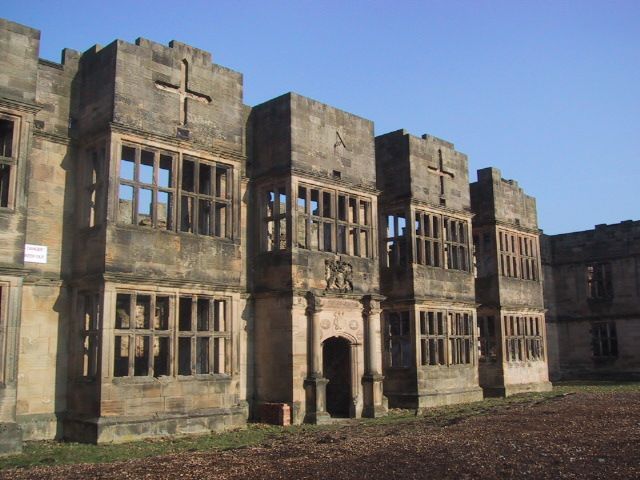
Gibside Hall, 17th to 19th century country house - Scheduling

-
Description
Country houses of the late Tudor and early Jacobean period comprise a distinctive group of buildings which differ in form, function, design and architectural style from country houses of both earlier and later date. Built after the dissolution of the monasteries they are the product of a particular historical period in which a newly-emerged Protestant elite of lawyers, courtiers, diplomats and other officials, mostly with close contacts at court, competed with each other to demonstrate wealth, taste and loyalty to the sovereign, often overstretching themselves financially. Their houses are a development of the medieval hall with flanking wings and a gatehouse, often looking inwards onto a courtyard; later examples tend to be built outwards, typically on a U- or H-plan. The hall was transformed from a reception area to an entrance vestibule and the long gallery and loggia were introduced. Many houses were provided with state apartments and extensive lodgings for the accommodation of royal visitors and their retinues. Country houses of this period were normally constructed under the supervision of one master-mason or a succession of masons, often combining a number of designs drawn up by the master-mason, surveyor or by the employer himself. Many designs and stylistic details were copied from Continental pattern-books, particularly those published in the 1560s on French, Italian and Flemish models...... -
Owner
Historic England -
Source
Local (Co-Curate) -
License
What does this mean? Unknown license check permission to reuse
-
Further information
Link: https://historicengland.org.uk/listing/the-list/list-entry/1017224
Resource type: Text/Website
Added by: Simon Cotterill
Last modified: 2 months ago
Viewed: 82 times
Picture Taken: Unknown -
Co-Curate tags