Topics > Heritage Sites > Newcastle Town Walls > Plummer Tower
Plummer Tower

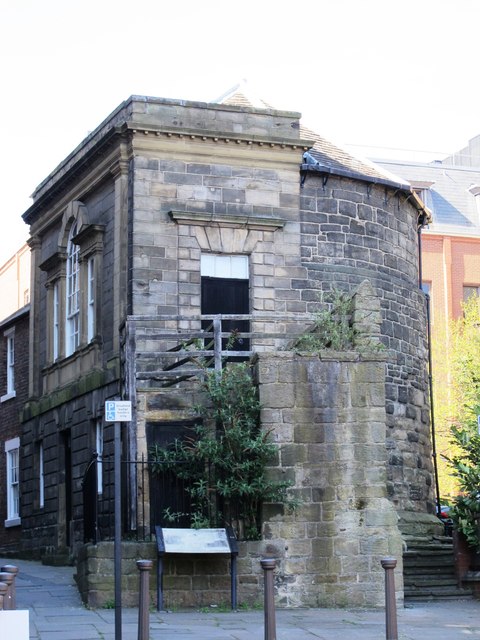
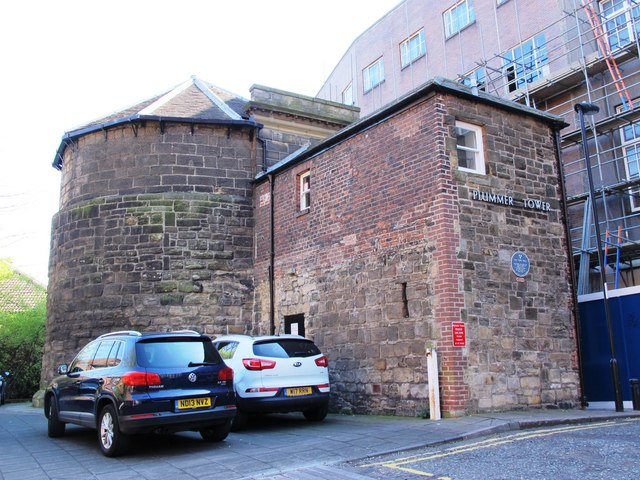
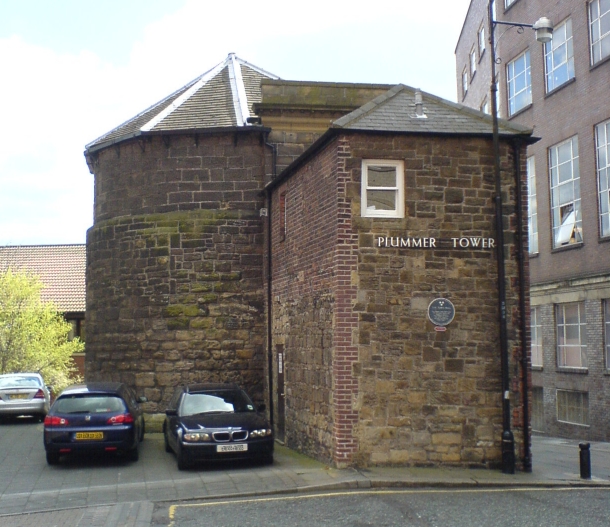 Plummer Tower, located on what is now Croft Street, was part of Newcastle's Town Walls, built in the 13th and 14th century. During the Civil War, Plummer Tower was converted into an artillery bastion by the addition of an outwork surrounding the tower. In the 17th century it was used by the Company of Cutlers, and in the 18th century, by the Company of Masons. The tower and bastion, together with a small section of connected curtain wall are a Scheduled Monument (legally protected). The towe is also Grade I listed on the National Heritage List for England. "Carliol Croft Tower, otherwise Plummer Tower. - This was also called the Cutlers' Tower, having once been the hall of that company, who are now extinct. In 1742, it was granted to the fraternity of Masons, by whom it was repaired and fronted in a handsome manner. It will soon be hid amidst a crowd of buildings" (Eneas Mackenzie, 1827).
Scheduled Monument (#1019812): Newcastle upon Tyne town defences: section of curtain wall including Plummer Tower and a 17th century bastion
Click the headings below to expand (selected extracts from the Historic England scheduling)
Given the role played by the town defences in one of England's major commercial towns, and their contribution towards an understanding of medieval and later urban development, all sections of Newcastle's town defences that exhibit significant archaeological remains are considered to be nationally important. In spite of the fact that they have been modified in the post-medieval period, the standing and buried remains of the medieval town defences in Croft Street survive reasonably well. The length of curtain wall containing a tower is a rare survival, particularly on the east side of the circuit, where the curtain wall and its associated features are visible in few locations.
The survival of a 17th century bastion, constructed to strengthen the defences of Newcastle during the Civil War, is the only surviving example known on the defensive circuit, and this enhances the importance of the remains. As a monument which is visible to the public, this section of Newcastle's town defences serves as an important educational and recreational resource which will increase our understanding of how Newcastle's defences developed through time.
The monument is situated at the southern end of Croft Street immediately opposite Plummer House. It includes the upstanding and buried remains of part of the town defences of Newcastle upon Tyne. The section of town defences in Croft Street represent part of the eastern side of the circuit and includes two short lengths of curtain wall, a tower and a 17th century bastion. The tower and the upstanding length of curtain wall are a Listed Building Grade I. Further sections of the town defences to the south and west are the subject of separate schedulings.
Newcastle upon Tyne town defences were constructed from the mid-13th century to the middle or late 14th century enclosing an area of more than 60ha; the riverside lengths of curtain wall were added during the 15th century. The masonry defences were strengthened by a berm and a ditch, except on the south side where they were bounded by the River Tyne. Gateways were built at the principal points of entry to the town. Internally a cobbled inter-mural lane followed the line of the defences. The defences were refurbished during the medieval period and were reinforced and repaired several times during the post-medieval period.
The first length of curtain wall within this section is attached to the south side of the tower and is 7.6m long, standing 4.25m high to the parapet walkway. Rising above the walkway, the parapet is 1.15m high and is complete with its ridged coping stones. Two building phases are visible in this short stretch of curtain wall indicating that the curtain wall and the attached tower were built separately. Excavation in 1989 showed that the wall has rubble foundations within a trench 0.70m deep. On the external face, the curtain wall retains a double chamfer. Within the thickness of the curtain wall near its junction with the tower, there is a small irregularly shaped chamber; although not visible today, antiquarians recorded the existence of a blocked doorway connecting this chamber to the ground floor of the tower. It is thought that the area of the modern mural chamber was, in medieval times, the site of a short stair rising from within a corner of the tower giving access to the wall walk. The second length of curtain wall, attached to the north side of the tower, is about 6m long and is thought to survive as a buried feature below the 19th century extension to the north of Plummer Tower.
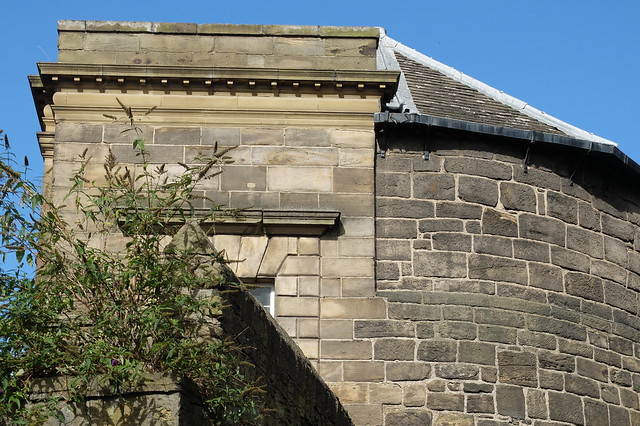
The tower, known as Plummer Tower projects some 4m from the outer face of the curtain wall. It is visible as a semicircular shaped structure constructed of coursed and squared ashlar sandstone standing up to 4.5m high. Above two of the lower courses of the tower there is an external chamfer course. Excavation in 1989 showed that the tower was founded on a single course of angular sandstone blocks laid within a trench about 0.28m deep. Although the interior of the tower has been much altered, it is thought that it contained a single chamber covered by a vaulted roof.
At the time of the Civil War, Plummer Tower was converted into an artillery bastion by the addition of an outwork surrounding the tower on its north, east and south sides. During the 1989 excavations part of this structure was uncovered; it was revealed to consist of an arrow-shaped stone built structure whose outer face was visible as ashlar sandstone with a rubble core resting on reused wooden planks. Within the area examined a single wooden beam was set horizontally within the stone wall where it would have projected beyond the wall of the bastion; this feature is thought to have served as a form of timber lacing.
Outside the stone built bastion there was a berm 1m wide flanked by what was thought to be a substantial flat-bottomed ditch. Partial excavation of the deposits within the ditch produced pieces of pottery and other objects dating from the mid- to late 17th century. Three musket balls were recovered from excavation trenches to the north, east and south of the bastion. Although the full extent of the bastion was not uncovered, its form suggests that it is of arrow head type with the point of the arrow immediately opposite, and 7m from, the centre of Plummer Tower.
The tower was modified further during the 17th century when it housed the Company of Cutlers and during the 18th century when it was obtained by the Company of Masons. During the 18th century an upper storey and a new western facade were added and subsequently a new external stair was built to the south side of the tower. In the 19th century, when the upper levels of the curtain wall were levelled to provide building stone, an extension to the north of the tower was added.

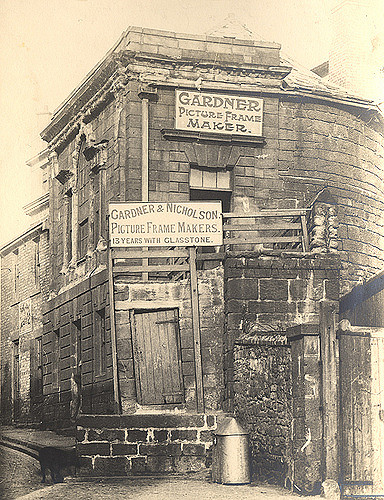
from Newcastle libraries (flickr)
003794:Plummer Tower Newcastle upon Tyne Unknown 1915?
Pinned by Simon Cotterill
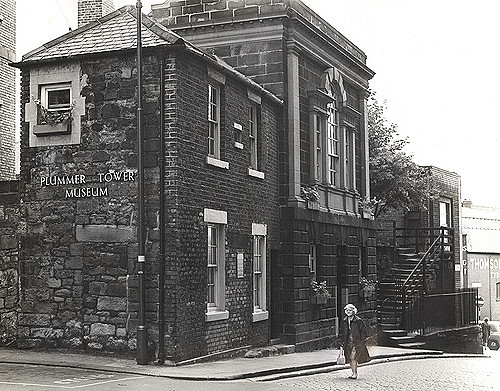
from Newcastle libraries (flickr)
013484:Plummer Tower Newcastle upon Tyne Unknown 1964
Pinned by Simon Cotterill

from https://en.wikipedia.org/wiki…
Plummer Tower in Newcastle upon Tyne
- Photo by Dbam, April 2007, public domain image c/o Wikipedia.
Added by
Simon Cotterill
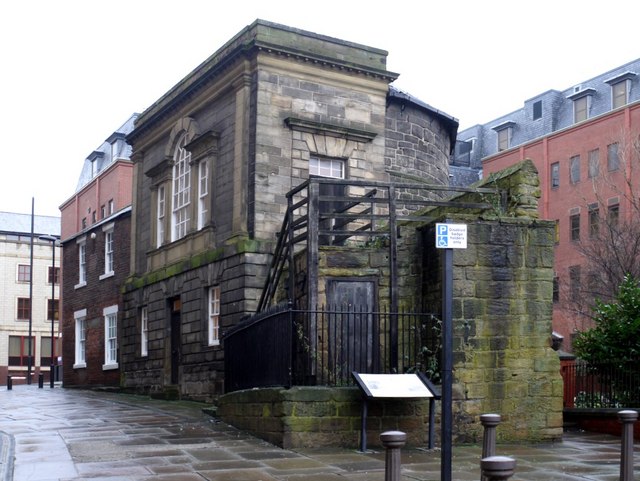

from http://twsitelines.info/SMR/1…
Tyne and Wear HER(1553): Newcastle town wall, Plummer Tower
- "A semi-circular, much restored tower, which earlier writers have suggested was originally of two storeys (like Carliol Tower). In his recent description, however, Nolan points out that medieval masonry survives …
Added by
Simon Cotterill
from https://historicengland.org.u…
PLUMMER TOWER - Newcastle - List Entry
- "Town Wall tower, later Company Meeting Hall, now offices. Late C13/early C14; refronted c.1740; house added late C18. Sandstone tower, coursed and squared, with ashlar front and returns; Welsh slate …
Added by
Simon Cotterill
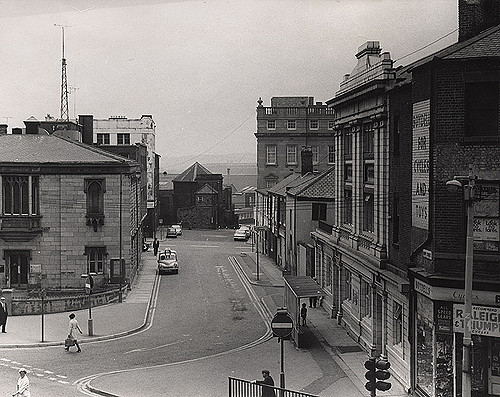
from Newcastle libraries (flickr)
022017:Croft Street, Newcastle Upon Tyne, Signey J. 1972
Pinned by Simon Cotterill
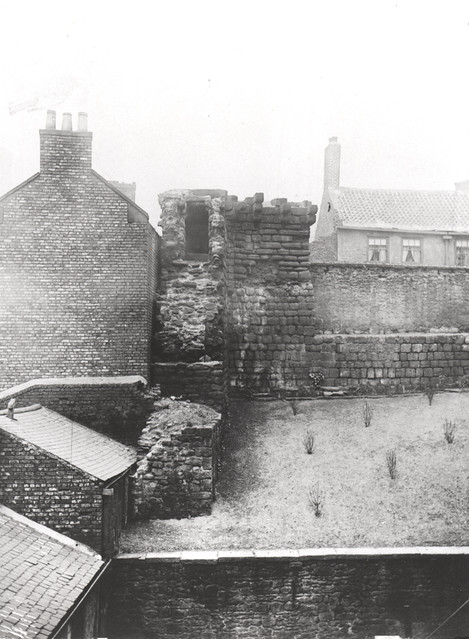
from Newcastle libraries (flickr)
059816:Croft Tower Newcastle upon Tyne Unknown Undated
Pinned by Simon Cotterill

from Newcastle libraries (flickr)
003794:Plummer Tower Newcastle upon Tyne Unknown 1915?
Pinned by Simon Cotterill
from Newcastle libraries (flickr)
013484:Plummer Tower Newcastle upon Tyne Unknown 1964
Pinned by Simon Cotterill
from https://en.wikipedia.org/wiki…
Plummer Tower in Newcastle upon Tyne
- Photo by Dbam, April 2007, public domain image c/o Wikipedia.
Added by
Simon Cotterill
from http://twsitelines.info/SMR/1…
Tyne and Wear HER(1553): Newcastle town wall, Plummer Tower
- "A semi-circular, much restored tower, which earlier writers have suggested was originally of two storeys (like Carliol Tower). In his recent description, however, Nolan points out that medieval masonry survives …
Added by
Simon Cotterill
from https://historicengland.org.u…
PLUMMER TOWER - Newcastle - List Entry
- "Town Wall tower, later Company Meeting Hall, now offices. Late C13/early C14; refronted c.1740; house added late C18. Sandstone tower, coursed and squared, with ashlar front and returns; Welsh slate …
Added by
Simon Cotterill
from Newcastle libraries (flickr)
022017:Croft Street, Newcastle Upon Tyne, Signey J. 1972
Pinned by Simon Cotterill
from Newcastle libraries (flickr)
059816:Croft Tower Newcastle upon Tyne Unknown Undated
Pinned by Simon Cotterill

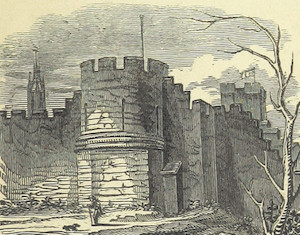

List number: 1024884
Tyne & Wear HER: 1553
Post code: NE1 6NG
Borough: Newcastle
Grid ref: NZ2520064416