Topics > Tyne and Wear > Newcastle upon Tyne > Hazlerigg > Iron Age / Romano-British settlement, Hazlerigg
Iron Age / Romano-British settlement, Hazlerigg
Scheduled Monument area - based on Historic England data (Open Government Licence).
To the south of Hezlerigg in Newcastle are the sites of two enclosed settlements of late Iron Age or Romano-British date. This is an archaeological site, with no visible surface remains, other than cropmarks. The site is a Scheduled Monument (legally protected). Nearby, a third site, including a roundhouse and ditches, dated to the Iron Age, was excavated in 2013.[1]
Scheduled Monument (#1020703): Two rectilinear enclosed settlements, south of Castle Street
Click the headings below to expand (selected extracts from the Historic England scheduling)
Despite disturbance and the levelling of all upstanding remains, significant information about the date and form of construction of the settlement at Hazlerigg will survive. Important archaeological deposits will survive below the present ground surface, which will reveal the date and evolution of the settlement and the form of its component structures. Important evidence for the nature and duration of occupation will survive within the settlement areas and the internal floor areas of the hut circles. Evidence for earlier land use and the contemporary environment and economy will be preserved within the buried ditches and other subsoil features. Overall the site will contribute to further study of the late Iron Age and Romano-British settlement patterns in this area.
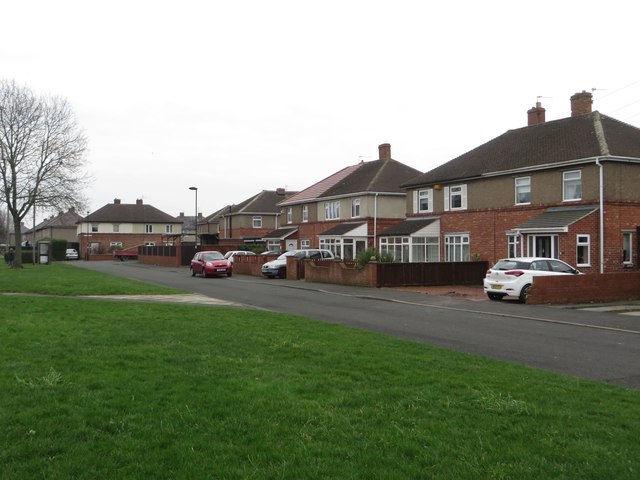
The monument includes two rectangular enclosured settlements, visible as crop marks, situated in an arable field immediately to the south of a housing estate towards the southern fringe of Hazlerigg. They are located on heavy clay loams and boulder clay overlying Upper Carboniferous deposits. Their similarity to comparable excavated sites in the north east indicates that they are of late Iron Age or Romano-British date. Further settlement remains, including hut circles, lying outside the enclosures are also included. These remains are in two separate areas of protection.
The northern of the two settlements is sub-square in plan, with rounded corners and includes two close set ditches. The outer of the two ditches encloses an area 75m by 75m, with an inner ditch set 10m inside it. The site has been investigated by geophysical survey and anomalies interpreted as the remains of two hut circles lie in close proximity to the enclosure. The first, immediately to the north of the northern side of the enclosure, measures 16m in diameter. The second, 30m to the south east of the south eastern corner of the enclosure, measures 14m in diameter.
The second of the two enclosured settlements is situated 140m to the south of the northern settlement, and is trapezoidal in plan, orientated north west to south east, and is thought to be defined by a single ditch. Each of the sides of the enclosure measure 60m, except for western side, which measures 50m. The area within and immediately around the enclosure retains the complex remains of a palimpsest of settlement activity, evidenced as geophysical anomalies. The remains of settlement activity include a series of seven intercutting hut circles, a pair of intercutting hut circles, a lone hut circle, a ditch and a curvilinear ditch. Five of the seven intercutting hut circles are located within the trapezoidal enclosure, with the remaining two, either cutting or cut by the northern side of the enclosure. The hut circles range from 7m to 20m in diameter and are thought largely to be non-contemporaneous. The pair of intercutting hut circles are located approximately 16m to the west of the western side of the trapezoidal enclosure. The larger of the two measures 14m in diameter, and the smaller, 10m in diameter. The lone hut circle is located 7m to the east of the eastern side of the trapezoidal enclosure and measures 10m in diameter. The ditch is orientated north to south, begins 14m from the north west corner of the trapezoidal enclosure and continues north for 30m. The curvilinear ditch is orientated east to west, begins 70m from the north east corner of the trapezoidal enclosure and continues west for 50m.

from https://historicengland.org.u…
Two rectilinear enclosed settlements, south of Castle Street - Hazlerigg - Scheduling
- ...The monument includes two rectangular enclosured settlements, visible as crop marks, situated in an arable field immediately to the south of a housing estate towards the southern fringe of Hazlerigg. …
Added by
Simon Cotterill
from https://www.twsitelines.info/…
Hazlerigg rectilinear enclosure (north)
- A rectilinear double-ditched enclosure visible on aerial photographs, 80 m long and 60 m wide with internal features (possible hut circles or traces of mining) and a single entrance, visible …
Added by
Simon Cotterill
from https://www.twsitelines.info/…
Hazlerigg rectilinear enclosure (south)
- A trapezoidal ditched enclosure visible on aerial photographs, 70 m long and 50 m wide, visible as a crop mark, with a single entrance visible but no internal features apparent. …
Added by
Simon Cotterill

from https://historicengland.org.u…
Two rectilinear enclosed settlements, south of Castle Street - Hazlerigg - Scheduling
- ...The monument includes two rectangular enclosured settlements, visible as crop marks, situated in an arable field immediately to the south of a housing estate towards the southern fringe of Hazlerigg. …
Added by
Simon Cotterill
from https://www.twsitelines.info/…
Hazlerigg rectilinear enclosure (north)
- A rectilinear double-ditched enclosure visible on aerial photographs, 80 m long and 60 m wide with internal features (possible hut circles or traces of mining) and a single entrance, visible …
Added by
Simon Cotterill
from https://www.twsitelines.info/…
Hazlerigg rectilinear enclosure (south)
- A trapezoidal ditched enclosure visible on aerial photographs, 70 m long and 50 m wide, visible as a crop mark, with a single entrance visible but no internal features apparent. …
Added by
Simon Cotterill