Topics > Heritage Sites > Newcastle Town Walls > Durham Tower
Durham Tower

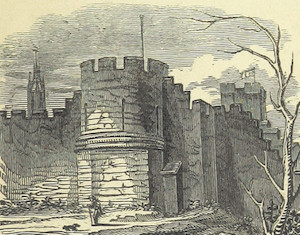
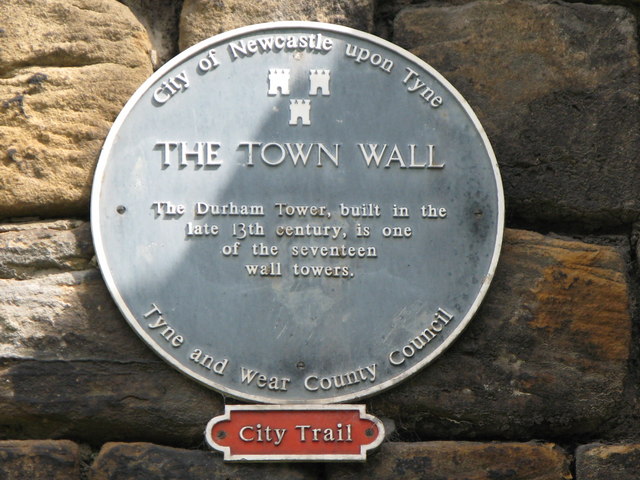
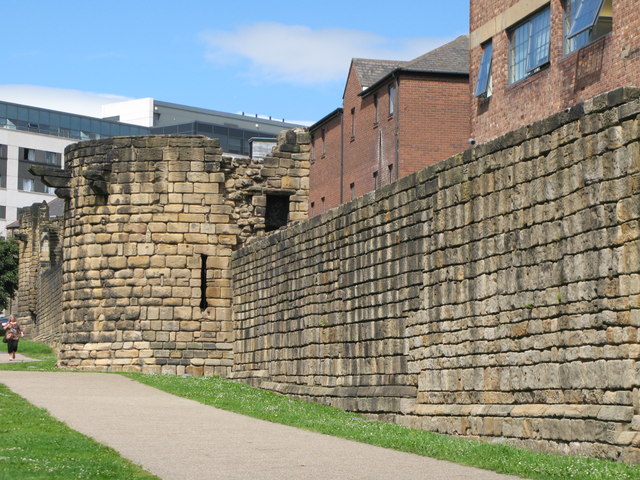 Durham Tower was built as part of Newcastle's Town Wall during the late 13th century. It was a single-storey semi-circular tower with a strong rib-vaulted room. The section of wall around Durham Tower runs parallel with Bath Lane. It is amongst the most complete parts of the Town Wall left today. The tower, curtain wall, and ditch are a scheduled ancient monument and Grade I listed on the National Heritage List for England.
Scheduled Monument (#1019279): Newcastle upon Tyne town defences: section of curtain wall including Durham Tower and section of town ditch
Click the headings below to expand (selected extracts from the Historic England scheduling)
The standing remains of the medieval town wall between Stowell Street and Westgate Road survive very well. The length of curtain wall containing a single turret and tower is a rare survival being one of few remaining locations where the curtain wall and its associated structures remain upstanding and highly visible. The buried remains of the berm and ditch represent one of few remaining locations within the city where these features are thought to survive. As a monument which is accessible to the public, this section of Newcastle town defences serves as an important educational and recreational resource which will increase our understanding of how Newcastle's defences developed.
The monument is situated between Stowell Street and Westgate Road and lies parallel to Bath Lane. It includes the upstanding and buried remains of part of the town defences of Newcastle upon Tyne. The section of town defences between Stowell Street and Westgate Road represents part of the western side of the circuit and includes a 90m upstanding section of curtain wall, a tower and a turret.Outside the wall there is a length of berm and part of the town ditch; the latter survives below ground level as an infilled and buried feature. The curtain wall, tower and turret are a Listed Building Grade I. Further sections of the town defences to the north west and south east are the subject of separate schedulings.
Newcastle upon Tyne town defences were constructed from the mid-13th century to the middle or late 14th century, enclosing an area of more than 60ha; the riverside lengths of curtain wall were added during the 15th century. The masonry defences were strengthened by a berm and a ditch, except on the south side where they were bounded by the River Tyne. Gateways were built at the principal points of entry to the town. Internally a cobbled inter-mural lane followed the line of the defences. The defences were refurbished during the medieval period and were reinforced and repaired several times during the post-medieval period.
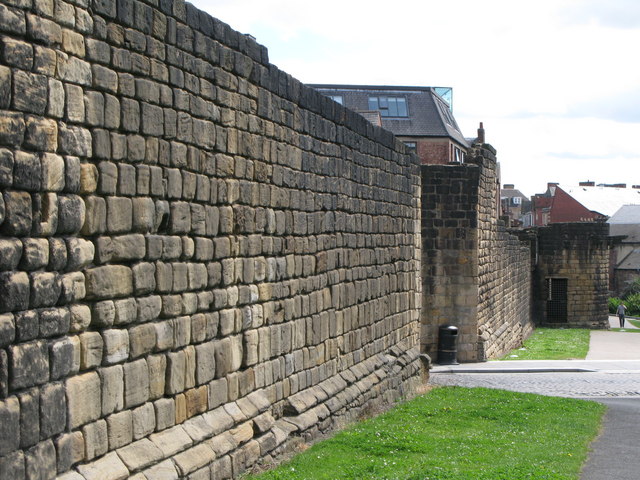
The curtain wall in this section is constructed of large, square sandstone blocks bonded with mortar. It is on average 2m wide and stands to a maximum height of 4m; in places the curtain wall retains part of the wall walk including the parapet and steep coping stones. The double chamfered lower courses are visible in this length of curtain wall; as the ground level within this area of the medieval town falls steeply from north to south, the lower levels of the wall are stepped down in a number of places.
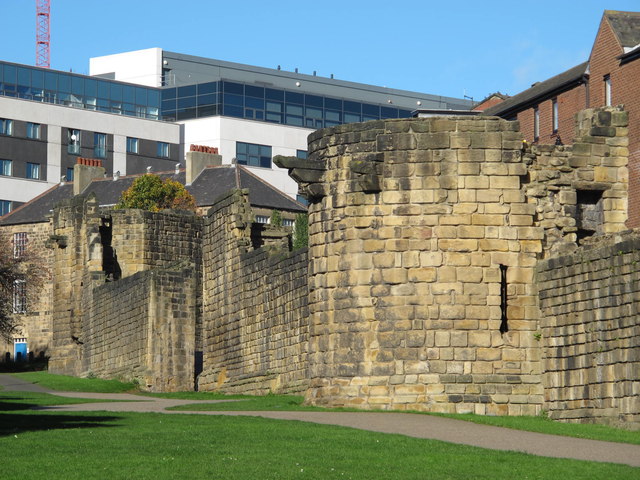
The tower, known as Durham Tower, is situated towards the north eastern end of the length of curtain wall and projects 4m from its outer face. The tower is visible as a semi-circular shaped building with a rectangular ground floor chamber constructed of coursed and squared ashlar sandstone blocks. The tower retains its stone vaulted roof and narrow window loops on the west and south sides. There is an entrance on the north side which retains a narrow stone lintel. Externally, the tower has several projecting corbels which are interpreted as supports for timber hoardings or galleries.
There is a single turret in this section at the junction of the curtain wall with Stowell Street. It is visible as a row of seven closely spaced corbels projecting from the inner face of the wall walk with four courses of superstructure remaining. In front of the curtain wall there are the remains of the berm and the infilled and buried remains of part of the town ditch which survives below ground level as a buried feature
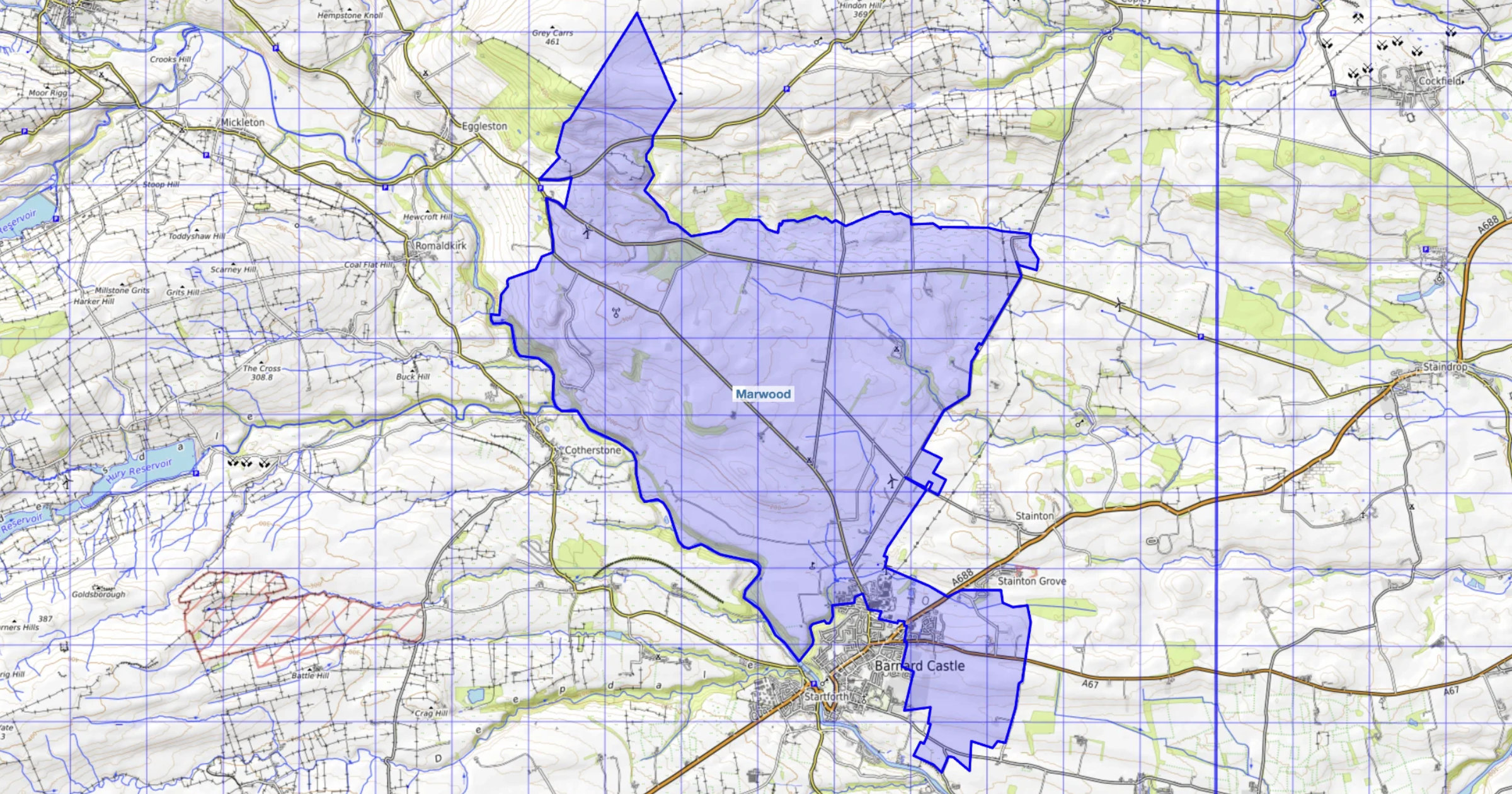
Scheduled Monument area - based on Historic England data (Open Government Licence).

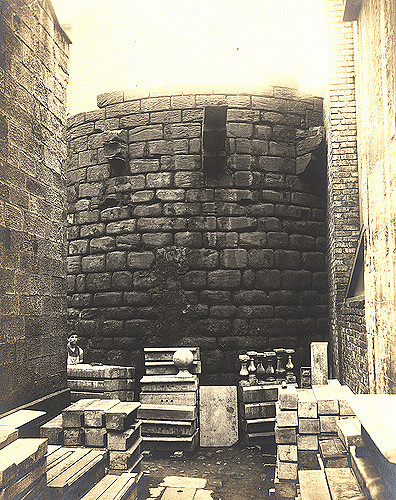
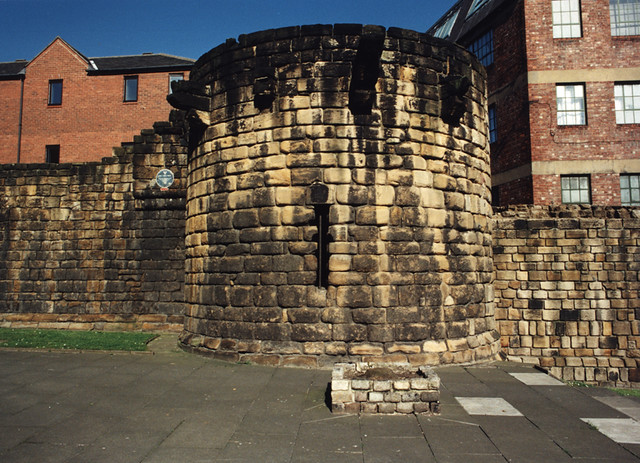
from Newcastle libraries (flickr)
061983:Durham Tower Bath Lane Maybury Malcolm 1995
Pinned by Simon Cotterill
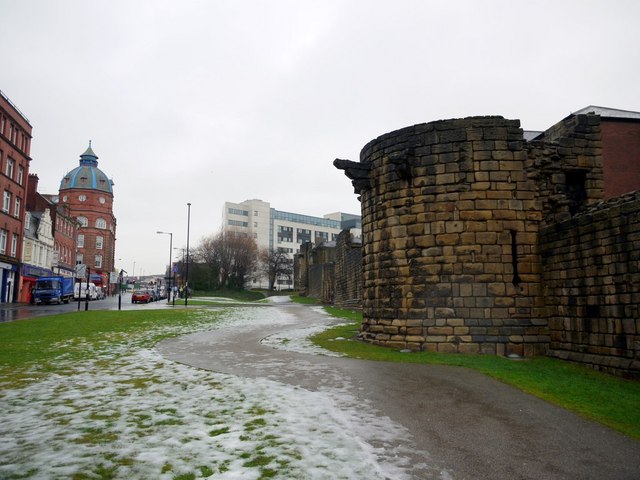
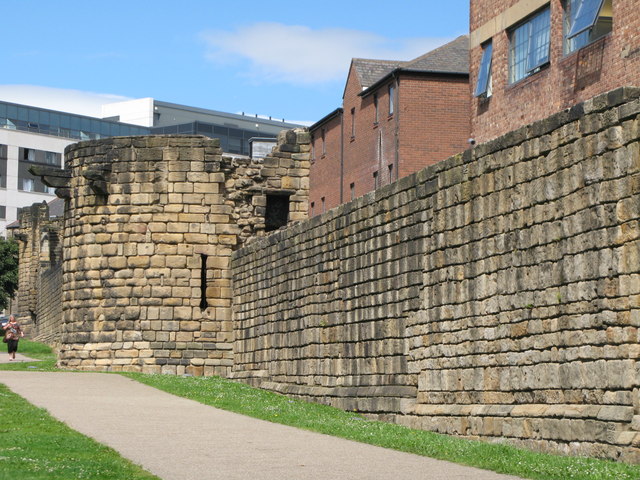
from http://twsitelines.info/SMR/1…
Tyne and Wear HER(1530): Newcastle town wall, Durham Tower
- "An almost complete example of a single-storeyed semi-circular tower. The rectangular rib-vaulted room is lit by two surviving loops (the third is now a door), and was originally entered from …
Added by
Simon Cotterill
from https://historicengland.org.u…
TOWN WALL WITH DURHAM TOWER
- "Town wall and tower. Late C13. Large sandstone blocks. High wall, part with walk and steeply-coped papapet; corbelled to turrets. Durham Tower: semi- circular external wall facing Bath Lane has …
Added by
Simon Cotterill

from Newcastle libraries (flickr)
061983:Durham Tower Bath Lane Maybury Malcolm 1995
Pinned by Simon Cotterill
from http://twsitelines.info/SMR/1…
Tyne and Wear HER(1530): Newcastle town wall, Durham Tower
- "An almost complete example of a single-storeyed semi-circular tower. The rectangular rib-vaulted room is lit by two surviving loops (the third is now a door), and was originally entered from …
Added by
Simon Cotterill
from https://historicengland.org.u…
TOWN WALL WITH DURHAM TOWER
- "Town wall and tower. Late C13. Large sandstone blocks. High wall, part with walk and steeply-coped papapet; corbelled to turrets. Durham Tower: semi- circular external wall facing Bath Lane has …
Added by
Simon Cotterill