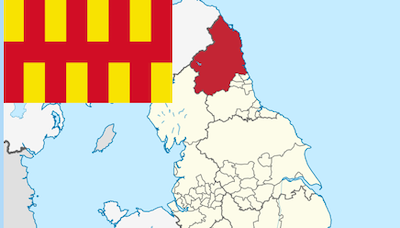
Topics > Northumberland > Civil Parishes in Northumberland > Berwick-upon-Tweed Town Council area > Camphill Settlement, Halidon Hill
Camphill Settlement, Halidon Hill
Scheduled Monument (#1003658): Camphill settlement
Click the headings below to expand (selected extracts from the Historic England scheduling)
Multivallate defended settlement 200m west of Camphill is preserved as a cropmark with analysis of aerial photographs indicating that archaeological and environmental deposits will be contained with features such as ditches and pits. These deposits will provide insight into the construction, use and abandonment of the monument and the use of the surrounding landscape. The monument provides insight into the character of fortification, settlement and subsistence during the Iron Age. Its value is enhanced by lying in close proximity to a similarly dated defended settlement located 660m to the west.
The monument includes the remains of a multivallate defended settlement of Iron Age date, situated on a south facing slope just off the ridge forming the eastern flank of Halidon Hill. The monument has been identified as cropmarks on aerial photos. The defended enclosure covers an area of 0.17ha. and is surrounded by three concentric curvilinear ditches with the whole measuring about 143m by 111m. There is a rectilinear annexe on the south west side of the main enclosure. This includes two large infilled pits.
The monument lies partly within the Battle of Halidon Hill Registered Battlefield and is 660m east of a second Iron Age defended settlement that is close to the summit of Halidon Hill and is the subject of a separate scheduling.
EN4135 Camphill, Northumberland
Click the headings below to expand (selected extracts from the Atlas of Hillforts of Britain and Ireland)
Lying just to the SE of Halidon Hill (Atlas No. 0501) on a slight south-facing slope, the cropmarked remains of a hillfort. The cropmarks are visible in an arable field as three concentric ditches with a maximum dimension of 105m by 90m, enclosing an area of approximately 0.17ha with a maximum footprint of 0.78ha, the outer ditch being the widest and the two inner ditches more closely spaced. No entrance can be identified but a road cuts through the site in the S and an entrance might have lain in this region. Internally maculae and possible pits can be seen. A rectangular annex has been recorded to the SW which contains two large maculae or large pits. A further section of ditch lies to the N. The site is not recorded on OS mapping. Minimal investigations, undated. Scheduled as a defended settlement but considered a hillfort here based on position and the scale of the enclosing works.
Source: Lock, Gary and Ralston, Ian. 2024. Atlas of Hillforts of Britain and Ireland. Available at: https://hillforts.arch.ox.ac.uk (CC BY-SA 4.0)


from https://historicengland.org.u…
Camphill settlement - Berwick-upon-Tweed - Scheduling
- During the mid-prehistoric period (seventh to fifth centuries BC) a variety of different types of defensive settlements began to be constructed and occupied in the northern uplands of England. The …
Added by
Simon Cotterill

from https://historicengland.org.u…
Camphill settlement - Berwick-upon-Tweed - Scheduling
- During the mid-prehistoric period (seventh to fifth centuries BC) a variety of different types of defensive settlements began to be constructed and occupied in the northern uplands of England. The …
Added by
Simon Cotterill