Topics > Heritage Sites > Hadrian's Wall > Wall Mile 70
Wall Mile 70
Hadrian's Wall - Wall Mile 70
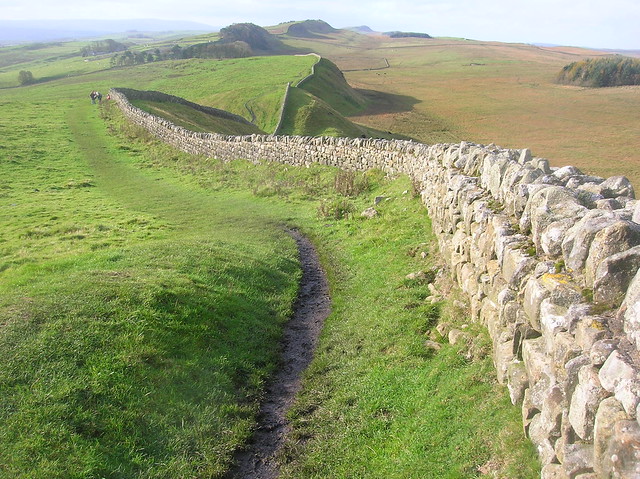
Hadrian's Wall stretches from the east to west coast of England and was an important frontier of the Roman Empire. Building of the wall began in AD 122 and took six years to complete it’s 84 mile (80 Roman mile) length. Soldiers were garrisoned along the line of the wall in large forts, smaller milecastles, and intervening turrets. The Vallum, a large ditch with mounds on either side, ran along the south side of the wall, protecting the rear of the frontier. Hadrian's Wall was designated as a World Heritage Site in 1987.
Wall mile 70 was originally a turf wall, later replaced by stone. From Milecastle 49 to the western end of Hadrian's Wall on the Solway Firth, the wall was originally constructed from turf, possibly due to the absence of limestone. Subsequently, the turf wall was demolished and replaced with a stone wall.
Wall Mile 70:
- Milecastle 70 (Braelees) - exact location unconfirmed. It is thought to lie between the villages of Kirkandrews-on-Eden and Beaumont to the north of Cowen Bank by the River Eden.
- Turret 70a - location unconfirmed. It's site is thought to be below the motte of the medieval castle at Beaumont.
- Turret 70b - location unconfirmed. It's calculated (assumed) location is 540 metres west of St Mary's Church to the south of Milldikes Lane.
The remains of Hadrian's Wall survive as a buried feature in Wall Mile 70. The vallum survives intermittently as a feature faintly visible on the ground. St Mary's Church in Beaumont was constructed in stone taken from the Wall.
Scheduled Monument (#1014696): Hadrian's Wall between the field boundary to the south of the site of St Andrew's Church and Eden Bank at Beaumont in wall miles 69 and 70
Click the headings below to expand (selected extracts from the Historic England scheduling)
Map showing the buried remains of Hadrian's Wall vallum in this section (Scheduled Monument area).
%
Hadrian's Wall survives as a buried feature throughout the whole of this section. The only remains visible on the ground are traces of the wall ditch either side of Monkhill Beck where it survives to a depth of 2m, having been used over time as a farm track. To the east of the beck the line of the Wall probably followed the crest of the river cliff, which is between 10m and 15m high, where a ditch would have been superfluous.
The precise location of milecastle 70 has not yet been confirmed; on the basis of the usual spacing it is expected to be located to the north of Cowen Bank.
The course of the Roman road known as the Military Way which ran along the corridor between the Wall and vallum linking turrets, milecastles and forts, has not yet been confirmed in this section. Its course usually runs parallel to the line of the Wall, set back a few metres to the south, unless the course had to be changed due to topographic constraints.
The medieval Church of St Andrew which partly overlies the line of the Wall, was held by the nuns of Marrick Priory in Yorkshire and is recorded to have been very poor. It is thought to have fallen into disuse at an early date, possibly by 1692 when St Mary's Church at Beaumont was established as the parish church. Remains of the 12th century chancel arch were still standing in the old graveyard until the beginning of the 19th century. The graveyard which extended over the site of the abandoned church remained in use until relatively recently; it had its origins as the graveyard of the medieval church. Antiquarian sources suggest that early grave slabs and coffins, all now lost, were discovered there.
Scheduled Monument (#1013510): Beaumont motte castle and section of Hadrian's Wall in wall mile 70 including turret 70a
Click the headings below to expand (selected extracts from the Historic England scheduling)
%
The monument includes Beaumont motte castle, beneath which are the buried remains of a length of Hadrian's Wall and a turret, 70a. The site is strategically situated on a local high point overlooking the River Eden and lies in Beaumont village beneath St Mary's Church and part of the churchyard.
Beneath the motte there are the foundations of a turf section of Hadrian's Wall; an excavation in the churchyard's western extension a few metres to the west of the motte in 1928 proved the existence of these remains.
It is also known that Hadrian's Wall changed alignment on the elevated ground beneath the motte. The Wall approached this high point on an approximate north west-south east alignment. On reaching the summit it swung 36 degrees to the west to follow an east-west alignment. At this angle turret 70a was constructed and its remains will also exist below the motte.
The motte is oval-shaped and measures approximately 45m north-south by 40m east-west and is up to 2m high.
The motte castle is thought to have been constructed by the le Brun family during the 12th century. In 1306 Sir Richard le Brun was lord of Beaumont but removed his residence to Drumburgh Castle, for which he received a licence to crenellate in 1307. However, it is probable that the motte had been abandoned shortly before this date for it is known that Sir Elias de Thirwall had been appointed rector of St Mary's Church in 1296. The church was restored during the 18th and 19th centuries.
Scheduled Monument (#1018457): Burgh by Sands Roman fort, Beaumont camp, Burgh Castle and Hadrian's Wall from boundary west of churchyard, Beaumont to Burgh Head in wall miles 70 and 71
Click the headings below to expand (selected extracts from the Historic England scheduling)
Map showing the buried remains of Hadrian's Wall, fort and camp in this section (Scheduled Monument area).
%
The monument includes Hadrian's Wall and its associated features between the field boundary at the west side of the churchyard belonging to St Mary's Church at Beaumont in the east and Burgh Head in Burgh by Sands in the west, as well as Burgh by Sands Roman fort, Beaumont temporary camp south of Hadrian's Wall and the site of a medieval earthwork castle known as Burgh Castle.
For deails of Burgh Roman Fort see: Wall Mile 70
Hadrian's Wall survives as a buried feature throughout the whole of this section. Its course in the area of Burgh Castle, south east of Speergarth Holes, has been confirmed by excavation by Hogg in 1950. The wall ditch was also confirmed to survive as a buried feature north of the Wall in the 1950 excavation.
In addition a further length of the Wall line was confirmed west of Burgh Castle by geophysical survey in 1991. The results of this survey indicate that there are two lines taken by the Wall, the southern one representing the primary Turf Wall running close to the modern road, while the second line heads north west from Burgh Castle and meets the north east corner of the fort, also identified in the geophysical survey. This more northern line is thought to represent a realignment of the Wall when the fort was built so that the fort lay wholly to the rear of the Wall and did not partly project north of it. This realignment may have been carried out as late as the third century AD.
The precise locations of turrets 70b, 71a and 71b have not yet been confirmed. On the basis of the usual spacing, turret 70b is expected to be located about 540m west of St Mary's Church to the south of Milldikes Lane, turret 71a near to the footbridge over Greathill Beck, and turret 71b is probably under the site of Burgh fort in the area of the modern graveyard
The course of the Roman road known as the Military Way, which ran along the corridor between the Wall and vallum linking turrets, milecastles and forts, has not yet been confirmed in this section. A length of road, 8m wide, is known approximately 60m east of the fort from excavations in 1980 by Jones, but it is uncertain if this was the Military Way or another street within the extra-mural civil settlement.
A Roman temporary camp has been identified 80m to the south of the west end of Milldikes Lane 40m south of the course of Hadrian's Wall on the gently sloping south facing side of a spur overlooking the Powburgh Beck. Although only the eastern segment of the camp was recorded from crop marks visible on aerial photographs, sufficient remains were identified to allow the full extent of the site to be postulated. The only complete side identified is the east side. The site of the camp is overlain by narrow ridge and furrow, the product of medieval or later cultivation on the site.
The course of the vallum in this section is known both from observations in the adjacent sections of Hadrian's Wall to the east and west. A substantial ditch to the south of the former vicarage was discovered in excavations in 1980 by Jones, and, although its full extent was not examined, it is likely to have been the ditch of the vallum. If this is so, the vallum in this section of the monument runs slightly to the north of the line depicted by the Ordnance Survey. There are no indications of the earthwork visible on the ground and it survives entirely as buried remains.
Scheduled Monument (1014697): Hadrian's Wall vallum between the dismantled railway west of Kirkandrews Farm and the dismantled railway south east of Burgh by Sands in wall miles 70 and 71
Click the headings below to expand (selected extracts from the Historic England scheduling)
Map showing the buried remains of Hadrian's Wall vallum in this section (Scheduled Monument area).
%
The vallum survives intermittently as a feature visible on the ground. However, its surface remains are generally slight and most of the remains survive as buried features. Where visible, the ditch is generally a slight depression averaging 15m wide. However to the west of Greathill Beck it survives up to 2.5m deep.




from https://historicengland.org.u…
Burgh by Sands Roman fort, Beaumont camp, Burgh Castle and Hadrian's Wall from boundary west of churchyard, Beaumont to Burgh Head in wall miles 70 and 71 - List Entry
- ...Hadrian's Wall, Burgh Roman fort and a Roman temporary camp from the east end of St Mary's Church at Beaumont to Burgh Head, survive as a series of buried remains. …
Added by
Simon Cotterill
from https://historicengland.org.u…
Hadrian's Wall vallum between the dismantled railway west of Kirkandrews Farm and the dismantled railway south east of Burgh by Sands in wall miles 70 and 71 - List Entry
- ...Hadrian's Wall vallum between the dismantled railway west of Kirkandrews Farm and the dismantled railway south east of Burgh by Sands survives as a series of buried and upstanding features....The …
Added by
Simon Cotterill
from https://historicengland.org.u…
Hadrian's Wall between the field boundary to the south of the site of St Andrew's Church and Eden Bank at Beaumont in wall miles 69 and 70 - List Entry
- ....Hadrian's Wall between the field boundary to the south of the site of St Andrew's Church and Eden Bank in Beaumont survives as a series of buried remains. Significant information …
Added by
Simon Cotterill
from https://historicengland.org.u…
Beaumont motte castle and section of Hadrian's Wall in wall mile 70 including turret 70a - List Entry
- ...The monument includes Beaumont motte castle, beneath which are the buried remains of a length of Hadrian's Wall and a turret, 70a. The site is strategically situated on a local …
Added by
Simon Cotterill

from https://historicengland.org.u…
Burgh by Sands Roman fort, Beaumont camp, Burgh Castle and Hadrian's Wall from boundary west of churchyard, Beaumont to Burgh Head in wall miles 70 and 71 - List Entry
- ...Hadrian's Wall, Burgh Roman fort and a Roman temporary camp from the east end of St Mary's Church at Beaumont to Burgh Head, survive as a series of buried remains. …
Added by
Simon Cotterill
from https://historicengland.org.u…
Hadrian's Wall vallum between the dismantled railway west of Kirkandrews Farm and the dismantled railway south east of Burgh by Sands in wall miles 70 and 71 - List Entry
- ...Hadrian's Wall vallum between the dismantled railway west of Kirkandrews Farm and the dismantled railway south east of Burgh by Sands survives as a series of buried and upstanding features....The …
Added by
Simon Cotterill
from https://historicengland.org.u…
Hadrian's Wall between the field boundary to the south of the site of St Andrew's Church and Eden Bank at Beaumont in wall miles 69 and 70 - List Entry
- ....Hadrian's Wall between the field boundary to the south of the site of St Andrew's Church and Eden Bank in Beaumont survives as a series of buried remains. Significant information …
Added by
Simon Cotterill
from https://historicengland.org.u…
Beaumont motte castle and section of Hadrian's Wall in wall mile 70 including turret 70a - List Entry
- ...The monument includes Beaumont motte castle, beneath which are the buried remains of a length of Hadrian's Wall and a turret, 70a. The site is strategically situated on a local …
Added by
Simon Cotterill