Topics > Heritage Sites > Hadrian's Wall > Wall Mile 47
Wall Mile 47
Hadrian's Wall - Wall Mile 47
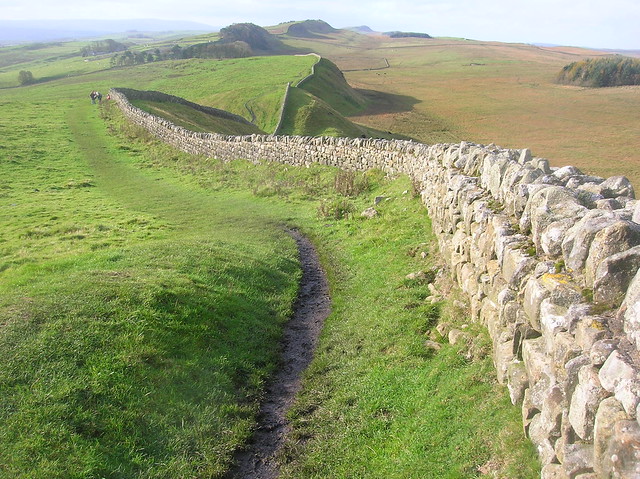
Hadrian's Wall stretches from the east to west coast of England and was an important frontier of the Roman Empire. Building of the wall began in AD 122 and took six years to complete it’s 84 mile (80 Roman mile) length. Soldiers were garrisoned along the line of the wall in large forts, smaller milecastles, and intervening turrets. The Vallum, a large ditch with mounds on either side, ran along the south side of the wall, protecting the rear of the frontier. Hadrian's Wall was designated as a World Heritage Site in 1987.
Wall Mile 47:
- Milecastle 47 (Chapel House)
- Turret 47a (Foultown)
- Turret 47b (Gap)
Scheduled Monument (#1010993): Hadrian's Wall, vallum, section of the Stanegate Roman road and a Roman temporary camp between the B6318 road and Poltross Burn in wall miles 46 and 47
Click the headings below to expand (selected extracts from the Historic England scheduling)
%
Hadrian's Wall survives as a buried feature throughout this section except for a short section of Wall less than 10m long which was excavated in 1957 ahead of road widening. The Wall here is consolidated and of broad wall foundation, 3.3m wide and up to 0.5m high. Between this section and milecastle 47 the Wall can be traced as a turf covered scarp measuring 3.5m wide and 0.4m high. A modern wall partly overlies this scarp. West of turret 47b the remains of the Wall are again visible as a turf covered scarp, 0.4m high, with a field wall occupying the centre line of the Wall. In the woodland above the east bank of Poltross Burn the Wall survives as a bank of tumbled stone which has a maximum height of 0.5m. Elsewhere the Wall survives as a buried feature with no remains visible above ground, being overlain by a field wall for most of its course. At Chapel House, farm buildings overlie the course of the Wall.
Milecastle 47 is situated about 250m east of Chapel House. It survives as a slight turf covered ploughed down platform. Dressed stones from the gate lie to the north on a modern causeway across the wall ditch. Excavations in 1935 uncovered large barrack blocks either side of the central space within the milecastle. An oven was found in the north west corner. This milecastle measures internally 21.2m north to south by 18.5m across.
The exact location of turret 47a has not yet been confirmed. On the basis of the usual spacing it is expected to lie about 220m west of Chapel House.
The exact location of turret 47b has not yet been confirmed. On the basis of the usual spacing it is expected to be located beneath the house and garden of `Meadow View'. No upstanding remains are visible above ground.
The exact course of the Roman road known as the Military Way, which ran along the corridor between the Wall and Vallum linking turrets, milecastles and forts, is not known with certainty throughout the whole of this section. The only visible remains survive as a terrace in a north facing slope to the south and west of Wall End farm. Elsewhere it survives as a buried feature beneath the turf cover with few traces visible above ground.
The vallum survives as an intermittent earthwork visible on the ground in parts of this section. Elsewhere it has been ploughed down and its remains survive as buried features masked by the turf cover. In the area of Greenhead Golf Course the extant ditch survives up to 1.8m deep and the north and south mounds up to 0.8m high. Either side of the Poltross Burn the vallum ditch is visible on the rim of the gorge where it measures 0.6m deep.
The east-west Roman road known as the Stanegate, which was a pre-Hadrianic construction dating to the early 80s AD, survives intermittently in this section as a feature visible on the ground. Where visible it survives as a linear turf covered mound, 0.4m high. Elsewhere its remains survive as buried features.
See our page: Stanegate for further details about the Roman Road.
A Roman temporary camp, known as Glenwhelt Leazes, is situated on Greenhead Golf Course. It is situated on the east end of a spur overlooking the gap in the Whin Sill escarpment cut by the Tipalt Burn. It survives as a series of earthworks visible on the ground. The defences are best preserved to the east of the north gateway where the rampart is up to 4m wide and 0.7m high and the outer ditch is 3m wide and 0.5m deep. This north facing rectangular camp measures 150m north to south by 80m across and encloses an area of 1.2ha. The four gateways are particularly significant in that each has both an internal and external defence bank and ditch visible on the ground. The interior has been ploughed and drained creating a levelled area.
Listed Building, Grade I (#1178450): Hadrians Wall, Milecastle and Turrets (milecastle 47; turrets 47A and 47B)




from https://historicengland.org.u…
HADRIANS WALL MILECASTLE AND TURRETS HADRIANS WALL, MILECASTLE AND TURRETS - List Entry
- "Hadrian's wall; milecastle 47; turrets 47A and 47B. AD 122, reconstructed AD 205. Rubble core with dressed stone faces. Course of wall runs west from Holmhead (NY 659660) to Gilsland …
Added by
Simon Cotterill
from https://historicengland.org.u…
Hadrian's Wall, vallum, section of the Stanegate Roman road and a Roman temporary camp between the B6318 road and Poltross Burn in wall miles 46 and 47 - List Entry
- ....The monument includes the section of Hadrian's Wall and vallum and their associated features between the B6318 road in the east and the Poltross Burn in the west. All the …
Added by
Simon Cotterill



from https://historicengland.org.u…
HADRIANS WALL MILECASTLE AND TURRETS HADRIANS WALL, MILECASTLE AND TURRETS - List Entry
- "Hadrian's wall; milecastle 47; turrets 47A and 47B. AD 122, reconstructed AD 205. Rubble core with dressed stone faces. Course of wall runs west from Holmhead (NY 659660) to Gilsland …
Added by
Simon Cotterill
from https://historicengland.org.u…
Hadrian's Wall, vallum, section of the Stanegate Roman road and a Roman temporary camp between the B6318 road and Poltross Burn in wall miles 46 and 47 - List Entry
- ....The monument includes the section of Hadrian's Wall and vallum and their associated features between the B6318 road in the east and the Poltross Burn in the west. All the …
Added by
Simon Cotterill