Topics > Northumberland > Civil Parishes in Northumberland > Biddlestone Civil Parish > Uplaw Knowe palisaded settlement
Uplaw Knowe palisaded settlement
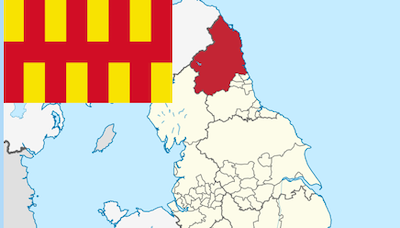
Map showing Uplaw Knowe palisaded settlement, to the NW of Clennell (zoom-in to view the Scheduled Monument area).
Uplaw Knowe is a modest hill of 370m height in the Cheviots in Northumberland. On the eastern slopes of Uplaw Knowe, about 2km north-west of Clennell, is the site of an Iron Age palisaded settlement. It consists of an oval enclosure defined by a timber palisade, now surviving as a low earthwork and cropmark, where a palisade trench once held wooden posts. Within the enclosure are the remains of at least two roundhouses, visible as ring‑grooves. The timber palisade represents an early phase of defence, predating later prehistoric earthwork ramparts seen elsewhere. There are other nearby Iron Age and Romano‑British settlements, including another palisaded site close to Hosedon Linn, which together, provide insight into settlement patterns, land use, and subsistence practices over a long period of later prehistory. This site at Uplaw Knowe is a Scheduled Monument (legally protected). Clennell Street, an old drove road over the Cheviots, passes nearby.
Scheduled Monument (#1006393): Uplaw Knowe palisaded settlement
Click the headings below to expand (selected extracts from the Historic England scheduling)
Excavation has demonstrated that at several sites the earthen defences were preceded by timber palisades. Palisaded enclosures are a rare monument type with fewer than 200 known examples. They are an important element of the later prehistoric settlement pattern and are important for any study of the developing use of defended settlements during the later prehistoric period. All identified surviving examples are believed to be nationally important.
The palisaded settlement east of Uplaw Knowe is reasonably well-preserved as a low earthwork with evidence of settlement in the form of hut circles. The monument will contain archaeological and environmental deposits which will provide insight into the contruction, use and abandonment of the settlement and the surrounding landscape. The significance of the monument is increased by the presence of other Iron Age/Romano-British settlement remains close to the south east. These remains include a broadly contemporary palisaded settlement NNE of Hosedon Linn. Taken together these monuments provide important insight into the character and development of settlement and subsistence during the Iron Age to the Romano-British period.
The monument includes the remains of a palisaded settlement of Iron Age date, situated on the east slopes of Uplaw Knowe. The enclosure is egg-shaped and is surrounded by a palisade trench preserved as a very low earthwork and in places as a cropmark. Within the interior of the enclosure are the remains of at least two hut circles with diameters of 13.5m and 14m, which are preserved as ring-grooves.

from https://keystothepast.info/se…
Uplaw Knowe palisaded settlement (Netherton with Biddlestone)
- .....Uplaw Knowe palisaded settlement, scheduled monument Northum 650. Palisaded settlements are the only evidence for domestic settlement for the first half of the first millennium BC in northern England and …
Added by
Simon Cotterill

from https://historicengland.org.u…
Uplaw Knowe palisaded settlement - Scheduling
- A palisaded hilltop enclosure is a small defended site of domestic function dating to the Late Bronze Age or Early Iron Age (c.550-440 BC). Their distribution is largely restricted to …
Added by
Simon Cotterill

from https://keystothepast.info/se…
Uplaw Knowe palisaded settlement (Netherton with Biddlestone)
- .....Uplaw Knowe palisaded settlement, scheduled monument Northum 650. Palisaded settlements are the only evidence for domestic settlement for the first half of the first millennium BC in northern England and …
Added by
Simon Cotterill
from https://historicengland.org.u…
Uplaw Knowe palisaded settlement - Scheduling
- A palisaded hilltop enclosure is a small defended site of domestic function dating to the Late Bronze Age or Early Iron Age (c.550-440 BC). Their distribution is largely restricted to …
Added by
Simon Cotterill