Topics > Historical Periods > Bronze Age > Round Barrow
Round Barrow
Round barrows were prehistoric burial sites, consisting of circular earth or stone mounds, mostly built during the late Neolithic to Bronze Age. They were often surrounded by a ring ditch, and served to mark territory as well as honoring ancestors.
Barrows varied and different types include bowl barrows (the most common type), bell barrows (separated by a flat berm), disc barrows (low mounds with banks and/or ditches), and pond barrows (dished depressions). Burials sometimes included items left for the after-life, such as pottery ("beaker" pottery), flint tools, weapons, and jewelry. Barrows were often situated in prominent or elevated positions, serving as boundary markers. It is thought that they were used for ritual gatherings, allowing communities to celebrate their dead and cement social relationships. Whilst mostly built in the Bronze Age, some barrows were later reused in the Roman and Anglo-Saxon periods. A barrows may sometimes be referred to as a tumulus (a broader term covering different types of burrial mounds).


Co-Curate Page
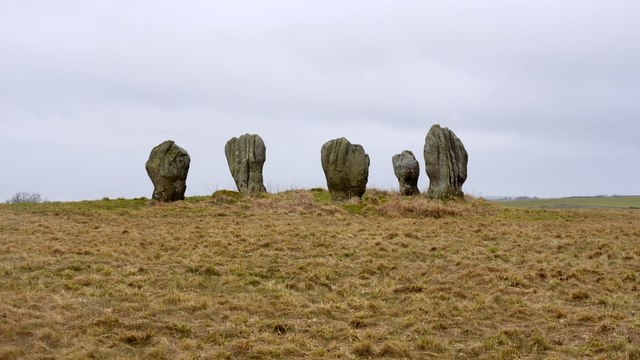
Dewley Hill round barrow
- Scheduled Monument area - based on Historic England data (Open Government Licence). Dewley Hill - photo by Andrew Curtis, CC-BY-SA Scheduled Monument (#1018678): Dewley Hill round barrow and associated features, …