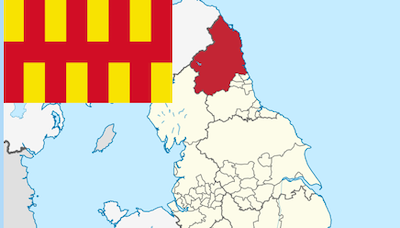
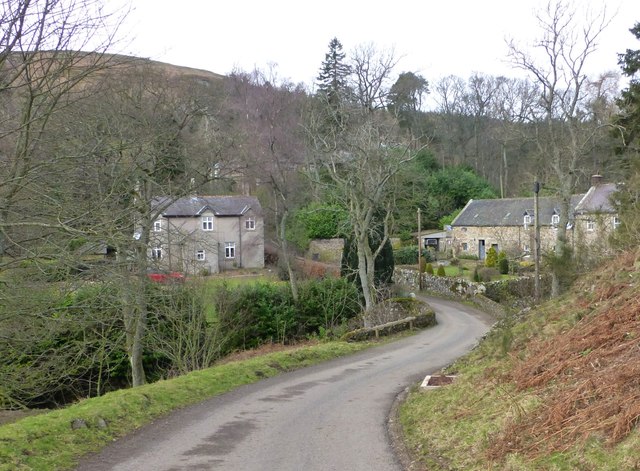
Topics > Northumberland > Linhope, Ingram > Greaves Ash camp
Greaves Ash camp
Scheduled Monument area - based on Historic England data (Open Government Licence).
Greaves Ash camp is the site of a large Iron Age and Romano-British settlement, situated on a spur by the River Breamish, to the east of Linhope in Northumberland. It features the remains of multiple stone-founded roundhouses, yards, and trackways, with evidence of continued occupation from the Iron Age into the Roman period. The site is a Scheduled Monument (legally protected).
EN2029 Greaves Ash Camp, Northumberland
Click the headings below to expand (selected extracts from the Atlas of Hillforts of Britain and Ireland)
Lying 180m to the NE of Linhope on an elevated spur to the S of the summit of Greaves Ash, a complex of Iron Age and Romano-British settlements, including the bivallate hillfort of Greaves Ash Camp. The hillfort lies to the W of the later settlement to which it is linked by a series of trackways and field systems. It overlies and partially destroys an earlier sub-oval enclosure. The bivallate fort is almost circular in plan with two concentric ramparts formed from parallel rows of boulders with rubble infill approximately 70m and 100m in diameter. The inner rampart measures 2.10m wide and 1.7m high and the more massive outer rampart 3.65m wide and 1.10m wide. Within the rampart core, transverse courses of stone provide greater structural stability to the rubble core of the rampart (Tate 1862, 295-6). No evidence of ditches. The NE extremity of the spur has been utilised to form a triangular annex enclosed by a single rampart of similar but slighter construction to the hillfort. Within this is a smaller sub-circular enclosure in the W. An enclosed settlement of four huts utilises the NE rampart of the annex. The outer rampart cuts through the earlier enclosed settlement in the NNE. The ramparts are separated by a berm up to 14.0m wide in places which has been sub-divided by small radial banks/walls. A small sub-oval enclosure overlies the outer rampart in the E. Internally 18 roundhouses were recorded during excavations in 1861 ranging from 3.3m to 8.2m in diameter with crudely faced walls up to 2m wide and 0.9 high and entrances facing E (Tate 1862, 313). The largest of these produced a fragment from a 2nd-4th century AD Roman glass bangle (Hope-Dodds 1935, 31). Querns were also recovered. The most probable entrance lies in the SE where a sunken trackway leads up to the hillfort. Recorded on 1856-65 OS mapping. Scheduled
Source: Lock, Gary and Ralston, Ian. 2024. Atlas of Hillforts of Britain and Ireland. Available at: https://hillforts.arch.ox.ac.uk (CC BY-SA 4.0)


from https://keystothepast.info/se…
Greaves Ash Camp (Ingram)
- ...The 'oppidum' at Greaves Ash was excavated in 1861 by the Berwick Naturalists' Club. It consists of three detached forts which nevertheless form one assemblage of dwellings and fortifications. The …
Added by
Simon Cotterill

from https://www.geograph.org.uk/p…
From fields to forts — Greaves Ash’s role in Roman Britain
- Photo by Mick Garratt, 31 October, 2023, Geograph: I see some squiggly lines on the map, paired with fancy Gothic writing, and I just can’t resist taking a look. And …
Added by
Simon Cotterill

from https://keystothepast.info/se…
Greaves Ash Camp (Ingram)
- ...The 'oppidum' at Greaves Ash was excavated in 1861 by the Berwick Naturalists' Club. It consists of three detached forts which nevertheless form one assemblage of dwellings and fortifications. The …
Added by
Simon Cotterill
from https://www.geograph.org.uk/p…
From fields to forts — Greaves Ash’s role in Roman Britain
- Photo by Mick Garratt, 31 October, 2023, Geograph: I see some squiggly lines on the map, paired with fancy Gothic writing, and I just can’t resist taking a look. And …
Added by
Simon Cotterill