Topics > Tyne and Wear > Gateshead > Whickham > Washingwells Roman fort, Whickham
Washingwells Roman fort, Whickham
Scheduled Monument area - based on Historic England data (Open Government Licence).
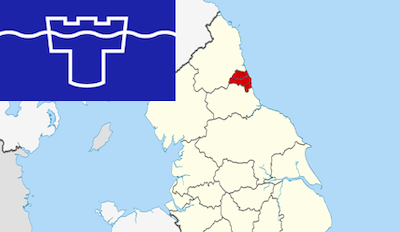
The site of Washingwells Roman fort is located to the east of Whickham, near Watergate Forest Park. The are no updstanding remains and the site was identified from cropmarks seen by arial photography in the 1970s. At least two phases of defensive ditches are visible. It is thought that the fort might have been associated with the 'Stanegate frontier', before the building of Hadrian's Wall.[1] The site is a Schedulled Munument (legally protected).
Scheduled Monument (#1018645): Washingwells Roman fort, Whickham
Click the headings below to expand (selected extracts from the Historic England scheduling)
Despite the lack of upstanding remains, Washingwells Roman fort is clearly visible on aerial photographs and the site will retain significant buried archaeological remains. Its location is unusual, and it is believed to date from the initial Roman conquest of the region, and to have been used as an outpost of the late first century Stanegate frontier line.
The monument includes the Roman fort known as Washingwells, which is situated 200m south of Washingwells Farm. It occupies a spur overlooking the Team Valley. The spur is bounded by steep slopes to its south and west, a gentle slope to the east and level ground to the north west.
The fort is identified from aerial photographs. It has three distinct ditch systems. The innermost ditch is the most complete, forming a south eastern facing polygonal enclosing 1.88ha. This ditch has three gateways identified from the aerial photgraphs; a fourth gateway on the south east side will exist opposite the north east gateway. The north east gateway has four post-pits indicating a timber gateway, 7.5m wide, sufficient for two portals. The middle ditch system is believed to be contemporary with the inner ditch system. It has been identified on the north west and north east sides. The outer ditch system has been identified on the north west and south east sides as a broad ditch, 8.75m wide.
On the north east side, it is apparent as a faint, narrow cropmark. In the southern angle of the fort are a series of four sunken ways of uncertain date running parallel to the present footpath.


from https://www.twsitelines.info/…
Washingwells Roman Fort
- he fort was discovered by aerial photography in 1970, identified from cropmarks. At least two phases of ditches are visible, perhaps more, and in the gaps in the later ditch …
Added by
Simon Cotterill

from https://historicengland.org.u…
Washingwells Roman fort, Whickham - Scheduling
- Roman forts served as permanent bases for auxiliary units of the Roman Army. In outline they were straight sided rectangular enclosures with rounded corners, defined by a single rampart of …
Added by
Simon Cotterill

from https://www.twsitelines.info/…
Washingwells Roman Fort
- he fort was discovered by aerial photography in 1970, identified from cropmarks. At least two phases of ditches are visible, perhaps more, and in the gaps in the later ditch …
Added by
Simon Cotterill
from https://historicengland.org.u…
Washingwells Roman fort, Whickham - Scheduling
- Roman forts served as permanent bases for auxiliary units of the Roman Army. In outline they were straight sided rectangular enclosures with rounded corners, defined by a single rampart of …
Added by
Simon Cotterill