Topics > Heritage Sites > Hadrian's Wall > Wall Mile 74
Wall Mile 74
Hadrian's Wall - Wall Mile 74
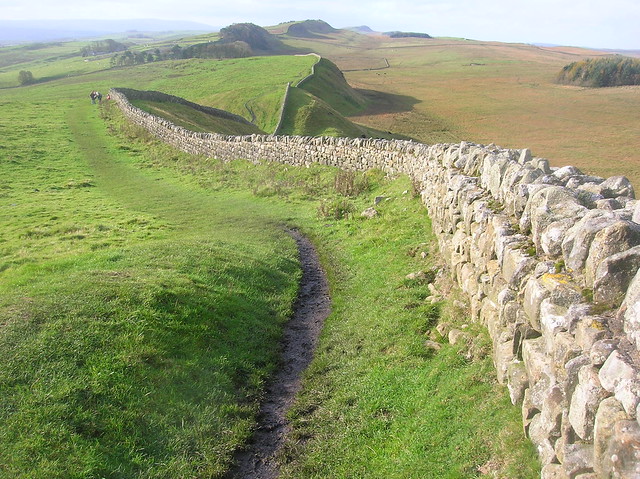
Hadrian's Wall stretches from the east to west coast of England and was an important frontier of the Roman Empire. Building of the wall began in AD 122 and took six years to complete it’s 84 mile (80 Roman mile) length. Soldiers were garrisoned along the line of the wall in large forts, smaller milecastles, and intervening turrets. The Vallum, a large ditch with mounds on either side, ran along the south side of the wall, protecting the rear of the frontier. Hadrian's Wall was designated as a World Heritage Site in 1987.
Wall mile 74 was originally part of the turf wall, later replaced by stone. From Milecastle 49 to the western end of Hadrian's Wall on the Solway Firth, the wall was originally constructed from turf, possibly due to the absence of limestone. Subsequently, the turf wall was demolished and replaced with a stone wall.
Wall Mile 74:
- Milecastle 74 (Burgh Marsh)
- Turret 74a - exact location unknown
- Turret 74b - exact location unknown
Did Hadrian's Wall cross Burgh Marsh?
Until recently there was no evidence that Hadrian's Wall was carried across Burgh Marsh, west of Dykefield. It had been theorized that the wet, unstable ground of the marsh would have been unsuitable for a massive stone or even turf wall structure, leading some to believe the Wall was diverted south along higher ground, or even that the Romans never built the Wall in the area!.
The "presumed" positions of Milecastle 74 and turrets 74a and 74b had been determined, along the assumed course of the Wall across Burgh Marsh, and based on expected spacing between neighbouring wall structures; but no actual remains had been found.
However, in October 2025, Archaeologists uncovered the best preserved section of Hadrian’s Wall found west of Carlisle. The excavations were made near Drumburgh, on ground sloping toward Burgh Marsh. A trench was excavated over a linear feature that had been identified by a previous geophysical survey. The initial excavation revealed foundation slabs for a section of Hadrian’s Wall. When the trench was extended eastwards, an exceptionally well preserved stretch of Wall was uncovered, standing up to four courses high, with both faces and the rubble core intact. The north face used vertical stones with signs of repair; the south face was built in stepped fashion.[1] The findings support the idea that the Wall did continue across Burgh Marsh, though further investigations are needed to confirm this.


from https://perlineamvalli.wordpr…
Wall Mile 74
- Wall Mile 74 (September 17, 2011). Mike Bishop's PLV blog about walking Hadrian’s Wall written from an archaeologist’s point of view. "As with Wall Mile 75, nothing is known about …
Added by
Simon Cotterill

from https://the-past.com/news/sec…
Section of Hadrian’s Wall discovered at Drumburgh
- Current Archaeology, November 30, 2025. "Excavations at Drumburgh, 10 miles (16km) from Carlisle, have unearthed a section of Hadrian’s Wall – the best-preserved part of the frontier fortification to be …
Added by
Simon Cotterill

from https://perlineamvalli.wordpr…
Wall Mile 74
- Wall Mile 74 (September 17, 2011). Mike Bishop's PLV blog about walking Hadrian’s Wall written from an archaeologist’s point of view. "As with Wall Mile 75, nothing is known about …
Added by
Simon Cotterill
from https://the-past.com/news/sec…
Section of Hadrian’s Wall discovered at Drumburgh
- Current Archaeology, November 30, 2025. "Excavations at Drumburgh, 10 miles (16km) from Carlisle, have unearthed a section of Hadrian’s Wall – the best-preserved part of the frontier fortification to be …
Added by
Simon Cotterill