Topics > Heritage Sites > Hadrian's Wall > Wall Mile 69
Wall Mile 69
Hadrian's Wall - Wall Mile 69
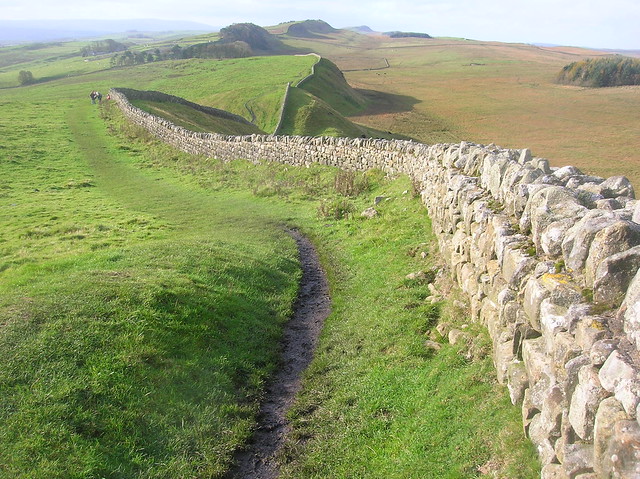
Hadrian's Wall stretches from the east to west coast of England and was an important frontier of the Roman Empire. Building of the wall began in AD 122 and took six years to complete it’s 84 mile (80 Roman mile) length. Soldiers were garrisoned along the line of the wall in large forts, smaller milecastles, and intervening turrets. The Vallum, a large ditch with mounds on either side, ran along the south side of the wall, protecting the rear of the frontier. Hadrian's Wall was designated as a World Heritage Site in 1987.
Wall mile 69 was originally a turf wall, later replaced by stone. From Milecastle 49 to the western end of Hadrian's Wall on the Solway Firth, the wall was originally constructed from turf, possibly due to the absence of limestone. Subsequently, the turf wall was demolished and replaced with a stone wall.
Wall Mile 69:
- Milecastle 69 (Sourmilk Bridge)
- Turret 69a
- Turret 69b
Scheduled Monument (#1014694): Hadrian's Wall between Grinsdale and the field boundary south of the site of St Andrew's Church, Kirkandrews on Eden in wall miles 68 and 69
Click the headings below to expand (selected extracts from the Historic England scheduling)
Map showing the buried remains of Hadrian's Wall in this section (Scheduled Monument area).
%
Hadrian's Wall survives as a buried feature throughout the whole of this section. Traces of the wall ditch are visible on the ground west of Grinsdale where it survives as a slight depression, up to 0.5m deep. Elsewhere in this section the course of the Wall and the wall ditch are not visible on the surface.
The precise location of milecastle 69 has not yet been confirmed. On the basis of the usual spacing it is expected to lie approximately 200m east of Sourmilk Bridge; however there is no surface indication of its position. It will survive as a buried feature, but in view of the uncertainty of the exact position of this milecastle and the milecastles to either side, milecastle 69 is not included in the scheduling.
The precise location of turrets 68b and 69a are also not yet confirmed. On the basis of the usual spacing, turret 68b is expected to be located west of Park Farm at Grinsdale, and turret 69a midway between Sourmilk Bridge and where Holme Lane runs closest to the Wall.
The course of the Roman road known as the Military Way, which ran along the corridor between the Wall and the vallum linking turrets, milecastles and forts, has not yet been confirmed in this section.
Scheduled Monument (#1014695): Hadrian's Wall vallum between Mill Beck and the field boundary east of Kirkandrews Farm in wall mile 69
Click the headings below to expand (selected extracts from the Historic England scheduling)
Map showing the buried remains of Hadrian's Wall vallum in this section (Scheduled Monument area).
%
The vallum survives as a slight intermittent earthwork, the line of the ditch being visible as a depression, 0.3m-0.4m deep and averaging 20m across. Elsewhere the ditch survives as a buried feature.
Scheduled Monument (#1014696): Hadrian's Wall between the field boundary to the south of the site of St Andrew's Church and Eden Bank at Beaumont in wall miles 69 and 70
Click the headings below to expand (selected extracts from the Historic England scheduling)
Map showing the buried remains of Hadrian's Wall in this section (Scheduled Monument area).
%
Hadrian's Wall survives as a buried feature throughout the whole of this section. The only remains visible on the ground are traces of the wall ditch either side of Monkhill Beck where it survives to a depth of 2m, having been used over time as a farm track. To the east of the beck the line of the Wall probably followed the crest of the river cliff, which is between 10m and 15m high, where a ditch would have been superfluous.
The precise location of turret 69b is also not yet confirmed; on the basis of the usual spacing it is probably located beneath the site of St Andrew's Church.
The course of the Roman road known as the Military Way which ran along the corridor between the Wall and vallum linking turrets, milecastles and forts, has not yet been confirmed in this section. Its course usually runs parallel to the line of the Wall, set back a few metres to the south, unless the course had to be changed due to topographic constraints.
The medieval Church of St Andrew which partly overlies the line of the Wall, was held by the nuns of Marrick Priory in Yorkshire and is recorded to have been very poor. It is thought to have fallen into disuse at an early date, possibly by 1692 when St Mary's Church at Beaumont was established as the parish church. Remains of the 12th century chancel arch were still standing in the old graveyard until the beginning of the 19th century. The graveyard which extended over the site of the abandoned church remained in use until relatively recently; it had its origins as the graveyard of the medieval church. Antiquarian sources suggest that early grave slabs and coffins, all now lost, were discovered there.




from https://historicengland.org.u…
Hadrian's Wall between the field boundary to the south of the site of St Andrew's Church and Eden Bank at Beaumont in wall miles 69 and 70 - List Entry
- ....Hadrian's Wall between the field boundary to the south of the site of St Andrew's Church and Eden Bank in Beaumont survives as a series of buried remains. Significant information …
Added by
Simon Cotterill
from https://historicengland.org.u…
Hadrian's Wall vallum between Mill Beck and the field boundary east of Kirkandrews Farm in wall mile 69 - List Entry
- ...The monument includes the section of Hadrian's Wall vallum between Mill Beck in the east and the field boundary east of Kirkandrews Farm in the west. The vallum survives as …
Added by
Simon Cotterill
from https://historicengland.org.u…
Hadrian's Wall between Grinsdale and the field boundary south of the site of St Andrew's Church, Kirkandrews on Eden in wall miles 68 and 69 - List Entry
- ....Hadrian's Wall and its associated features between Grinsdale and the site of St Andrew's Church, Kirkandrews on Eden survive as a series of buried remains. Significant information on the development …
Added by
Simon Cotterill

from https://perlineamvalli.wordpr…
Wall Mile 69 (West to East)
- Wall Mile 69 (October 4, 2011). Mike Bishop's PLV blog about walking Hadrian’s Wall written from an archaeologist’s point of view. "The curtain wall finally quits the riverside (but keeps …
Added by
Simon Cotterill

from https://www.heritagegateway.o…
Milecastle 69
- Hob Uid: 10582
Location :
Cumbria
Carlisle
Beaumont
Grid Ref : NY3660058100
Summary : Alleged site of a milecastle - no visible remains.
More information : (NY 3657 5811) MC …
Added by
Simon Cotterill

from https://historicengland.org.u…
Hadrian's Wall between the field boundary to the south of the site of St Andrew's Church and Eden Bank at Beaumont in wall miles 69 and 70 - List Entry
- ....Hadrian's Wall between the field boundary to the south of the site of St Andrew's Church and Eden Bank in Beaumont survives as a series of buried remains. Significant information …
Added by
Simon Cotterill
from https://historicengland.org.u…
Hadrian's Wall vallum between Mill Beck and the field boundary east of Kirkandrews Farm in wall mile 69 - List Entry
- ...The monument includes the section of Hadrian's Wall vallum between Mill Beck in the east and the field boundary east of Kirkandrews Farm in the west. The vallum survives as …
Added by
Simon Cotterill
from https://historicengland.org.u…
Hadrian's Wall between Grinsdale and the field boundary south of the site of St Andrew's Church, Kirkandrews on Eden in wall miles 68 and 69 - List Entry
- ....Hadrian's Wall and its associated features between Grinsdale and the site of St Andrew's Church, Kirkandrews on Eden survive as a series of buried remains. Significant information on the development …
Added by
Simon Cotterill
from https://perlineamvalli.wordpr…
Wall Mile 69 (West to East)
- Wall Mile 69 (October 4, 2011). Mike Bishop's PLV blog about walking Hadrian’s Wall written from an archaeologist’s point of view. "The curtain wall finally quits the riverside (but keeps …
Added by
Simon Cotterill
from https://www.heritagegateway.o…
Milecastle 69
- Hob Uid: 10582
Location :
Cumbria
Carlisle
Beaumont
Grid Ref : NY3660058100
Summary : Alleged site of a milecastle - no visible remains.
More information : (NY 3657 5811) MC …
Added by
Simon Cotterill