Topics > Heritage Sites > Hadrian's Wall > Wall Mile 62
Wall Mile 62
Hadrian's Wall - Wall Mile 62
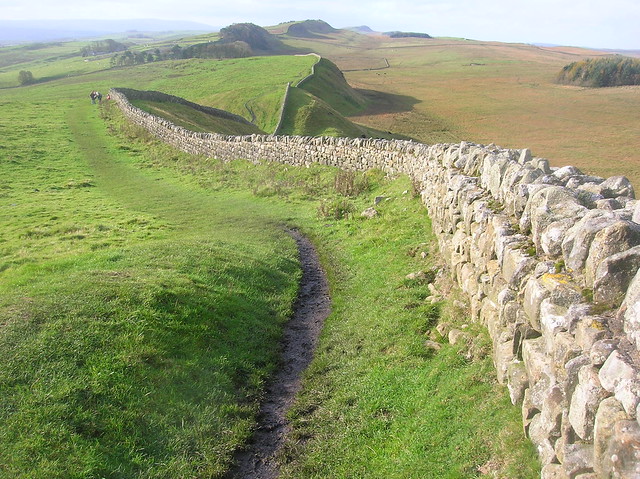
Hadrian's Wall stretches from the east to west coast of England and was an important frontier of the Roman Empire. Building of the wall began in AD 122 and took six years to complete it’s 84 mile (80 Roman mile) length. Soldiers were garrisoned along the line of the wall in large forts, smaller milecastles, and intervening turrets. The Vallum, a large ditch with mounds on either side, ran along the south side of the wall, protecting the rear of the frontier. Hadrian's Wall was designated as a World Heritage Site in 1987.
Wall mile 62 was originally part of the turf wall, later replaced by stone. From Milecastle 49 to the western end of Hadrian's Wall on the Solway Firth, the wall was originally constructed from turf, possibly due to the absence of limestone. Subsequently, the turf wall was demolished and replaced with a stone wall.
Wall Mile 62:
- Milecastle 62 (Walby East)
- Turret 62a
- Turret 62b
Scheduled Monument (#1010979): Hadrian's Wall and vallum between Baron's Dike and Birky Lane at Walby, in wall miles 60, 61 and 62
Click the headings below to expand (selected extracts from the Historic England scheduling)
%
Hadrian's Wall survives as a buried feature throughout this section. Its course is depicted on MacLauchlan's survey of the 1850s, but this course has not been confirmed in modern times. The Wall and its ditch were located during an excavation in advance of pipe laying east of Walby.
The wall ditch survives as an intermittent earthwork visible on the ground in the east half of this section, which also serves as a reliable guide to the course of the Wall here. Where visible the partly silted ditch averages 0.3m-0.8m deep with a modern drain cut into its base. Elsewhere the ditch is visible as a broad and shallow depression in the fields averaging 0.2m deep, also with a drain cut into its base. Its course has been confirmed in places through geophysical survey in 1981. In this section the ditch upcast mound, usually referred to as the glacis, survives as a feature faintly visible on the ground; elsewhere it survives as a buried feature.
The locations of milecastle 62 and turrets 61a and 61b have not yet been confirmed. On the basis of the usual spacing milecastle 62 is expected to be situated approximately 300m east of Walby Grange. Turrets 61a and 61b are expected to be situated at the usual distances between milecastles 61 and 62.
The course of the Roman road known as the Military Way, which ran along the corridor linking turrets, milecastles and forts, has been identified for a short distance to the east of Wallhead. There are no remains visible on the surface except for a short section of a turf covered mound, 4m-5m wide and up to 0.4m high. Its course was confirmed during excavation in 1894 by Haverfield. The road consisted of a gravel layer laid over larger stones with a stone kerb and central spine. Its survival here was confirmed by geophysical survey in 1981. However, the unusual survival of this section suggests the possibility that it was reused in the medieval period serving as access to Bleatarn Quarry.
South east of Wallhead the vallum survives as a slight earthwork visible on the ground as four parallel mounds, the most prominent ones being up to 1.2m high. Excavations by Hodgson took place here in 1894-5. Elsewhere the vallum survives as a buried feature with no remains visible on the ground except for a slight depression over the vallum ditch in a field 600m east of Walby Grange. However, the course shown on the Ordnance Survey map has been confirmed throughout this section by geophysical survey carried out in 1981. With the exception of the area to the east and south of Walby where three geophysical transects south of Walby Grange and Walby Croft showed the line of the vallum running about 40m north of the position given on Ordnance Survey maps. An excavation cut about 750m east of Walby Grange at the same time as the survey confirmed that the features picked up on the geophysical survey were those of the vallum.
Scheduled Monument (#1010980): Hadrian's Wall and vallum between Birky Lane at Walby and the east side of the M6 in wall miles 62 and 63
Click the headings below to expand (selected extracts from the Historic England scheduling)
%
Hadrian's Wall survives as a buried feature throughout this section with no remains visible above ground except for a low amorphous turf covered mound at Brunstock Park. However, a geophysical survey in 1981 and trial excavations by the Cumbria and Lancashire Archaeological Unit in 1989 have confirmed the course of the Wall at various points along this section.
The wall ditch survives intermittently as an upstanding earthwork in this section. At Brunstock Park the ditch is 8m-9m wide and 1.2m deep. It is cut in the east by a tractor crossing. Excavations were carried out here by Haverfield in 1894. Approximately 120m west of Walby Hall excavations by Goodburn in advance of the laying of a gas pipeline in 1975 encountered the ditch which measured 10.5m wide and 3.7m deep. Elsewhere the ditch is silted up but can be traced as a very faint depression in the fields, 0.15m deep. A geophysical survey in 1981 has shown that the wall ditch runs fractionally north west of its mapped line in two transects east of the electricity pylon line.
The exact locations of turrets 62a, 62b, 63a and 63b have not yet been confirmed. They are expected to be located at the usual spacings between the milecastles, approximately 500m apart.
The exact locations of turrets 62a, 62b, 63a and 63b have not yet been confirmed. They are expected to be located at the usual spacings between the milecastles, approximately 500m apart.
The position of the Roman road known as the Military Way, which ran along the corridor between the Wall and the vallum linking turrets, milecastles and forts, has not yet been confirmed throughout this section. The only part of it which is known is a short section found during excavation by Haverfield in 1894 approximately 80m west of the minor road between Houghton Hall and the B6264 road, 40m south of the extant wall ditch. The excavation revealed a denuded road, 6.5m wide, flanked by small side ditches. Elsewhere its remains survive as buried features.
The vallum survives as slight earthwork visible on the ground in Brunstock Park. The broad line of the ditch averages 0.4m deep and the ploughed down north and south mounds stand 0.2m high. Excavation of part of the vallum was carried out here by Haverfield in 1894. Elsewhere in this section its remains survive as buried features with no remains visible above ground. However, its course has been confirmed through geophysical survey in 1981 and in 1991. The various transects show that between Walby and the 'pinch' where the Wall and vallum are closest, the actual course of the vallum lies slightly to the north of where the course is depicted on Ordnance Survey maps. Excavations by Goodburn in 1975 in advance of the laying of a gas pipeline south west of Walby Hall located the vallum ditch 36m to the north of the line shown on the Ordnance Survey maps.



from https://historicengland.org.u…
Hadrian's Wall and vallum between Birky Lane at Walby and the east side of the M6 in wall miles 62 and 63 - List Entry
- ....Hadrian's Wall and vallum and their associated features between Birky Lane at Walby and the M6 survive well as a series of buried and upstanding remains. Significant information on the …
Added by
Simon Cotterill
from https://historicengland.org.u…
Hadrian's Wall and vallum between Baron's Dike and Birky Lane at Walby, in wall miles 60, 61 and 62 - List Entry
- ...Hadrian's Wall and vallum and their associated features between Baron's Dike and Birky Lane at Walby, survive well as a series of buried and visible remains. Significant information on the …
Added by
Simon Cotterill

from https://historicengland.org.u…
Hadrian's Wall and vallum between Birky Lane at Walby and the east side of the M6 in wall miles 62 and 63 - List Entry
- ....Hadrian's Wall and vallum and their associated features between Birky Lane at Walby and the M6 survive well as a series of buried and upstanding remains. Significant information on the …
Added by
Simon Cotterill
from https://historicengland.org.u…
Hadrian's Wall and vallum between Baron's Dike and Birky Lane at Walby, in wall miles 60, 61 and 62 - List Entry
- ...Hadrian's Wall and vallum and their associated features between Baron's Dike and Birky Lane at Walby, survive well as a series of buried and visible remains. Significant information on the …
Added by
Simon Cotterill