Topics > Heritage Sites > Hadrian's Wall > Wall Mile 57
Wall Mile 57
Hadrian's Wall - Wall Mile 57
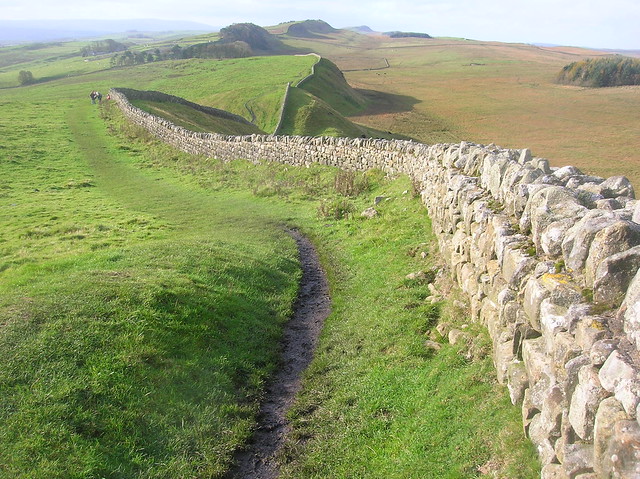
Hadrian's Wall stretches from the east to west coast of England and was an important frontier of the Roman Empire. Building of the wall began in AD 122 and took six years to complete it’s 84 mile (80 Roman mile) length. Soldiers were garrisoned along the line of the wall in large forts, smaller milecastles, and intervening turrets. The Vallum, a large ditch with mounds on either side, ran along the south side of the wall, protecting the rear of the frontier. Hadrian's Wall was designated as a World Heritage Site in 1987.
Wall mile 57 was originally a turf wall, later replaced by stone. From Milecastle 49 to the western end of Hadrian's Wall on the Solway Firth, the wall was originally constructed from turf, possibly due to the absence of limestone. Subsequently, the turf wall was demolished and replaced with a stone wall.
Wall Mile 57:
- Milecastle 57 (Cambeckhill)
- Turret 57a (Beck)
- Turret 57b - exact location unknown
Scheduled Monument (#1010986): Hadrian's Wall between the Cam Beck and Newtown Farm in wall miles 56 and 57
Click the headings below to expand (selected extracts from the Historic England scheduling)
%
Hadrian's Wall survives as a buried feature throughout this section with no remains visible above ground. Its course is indicated in this section by a broad swelling in the field to the south west of Cambeckhill farm and as occasional rises in hedgelines which cross its course. There is no surface trace at The Beck Farm or Heads Wood house.
The wall ditch survives as an intermittent earthwork visible on the ground. Where extant it averages 2m deep in the east half of the section and 1m deep in the west half. The ditch upcast mound, usually referred to as the glacis, has been ploughed out in this section and only survives faintly visible in the field south west of The Beck Farm.
The exact location of milecastle 57 has not yet been confirmed as there are no upstanding remains surviving above ground. However, on the basis of the usual spacing it is expected to be located below the farm at Cambeckhill. These buildings and the ground below them are not included in the scheduling as the survival of archaeological remains there has not been confirmed.
Turret 57a is situated about 180m south west of Dodgson's Beck. It was located in 1933 by Simpson who confirmed it as one from the Turf Wall series. It survives as a buried feature with a slight swelling visible above ground, 0.15m high, in the turf cover.
The exact location of turret 57b has not yet been confirmed. However, on the basis of the usual spacing it is expected to be situated about 110m north east of Newtown Farm.
The exact course of the Roman road known as the Military Way, which ran along the corridor between the Wall and vallum linking turrets, milecastles and forts, has not been confirmed in this section. It is probably positioned parallel to the Wall about 20m-30m south of it throughout the section as there are no topographical constraints.
Scheduled Monument (#1010987): The vallum between the field boundary south east of Heads Wood and the A6071 road in wall mile 57
Click the headings below to expand (selected extracts from the Historic England scheduling)
%
The vallum survives as a buried feature throughout this short section with no upstanding remains visible above ground. However, vague traces of the silted ditch are marked by slight depressions in the hedgelines which cross its course. Excavations by Haverfield in 1903 to locate the vallum succeeded in confirming its location and the extent of the remains. A geophysical survey in 1991 has also confirmed the course of the vallum here.
Scheduled Monument (#1010988): Hadrian's Wall and vallum from A6071 to The Cottage in the case of the Wall, and to the road to Oldwall, for the vallum, in wall miles 57, 58 and 59
Click the headings below to expand (selected extracts from the Historic England scheduling)
%
Hadrian's Wall survives as a buried feature throughout this section with no upstanding remains. Occasional rises in hedge lines and field walls are the only traces left on the surface.
Excavations by Haverfield in 1902 located the course of the Wall to the south west of Newtown where it runs parallel to a modern field boundary. A geophysical survey in 1981 indicated that masonry still survives in situ on the line of the Wall to the immediate south west of Newtown. It also suggested that there may be traces of the earlier Turf Wall on a slightly different alignment to the Stone Wall.
A centurial stone was discovered in this section of the Wall to the south of Cumrenton. Another centurial stone is known to be incorporated into the wall of Cumrenton farmhouse (not included in the scheduling). Between Chapel Field and Oldwall the course of the Wall is overlain by a hedge on top of an earth and stone bank, almost 2.5m wide.
The wall ditch survives as an intermittent earthwork visible on the ground throughout this section. In the north east half of this section the ditch survives as a slight depression traceable on the surface. Further to the south west the ditch survives in better condition, averaging 1.6m-1.8m deep. A modern drain runs along the base of the ditch here and a hedge runs along the north edge. The ditch upcast mound, usually referred to as the glacis, does not survive as a feature visible above ground in this section.
The exact course of the Roman road known as the Military Way, which ran along the corridor between the Wall and the vallum linking turrets, milecastles and forts, has not been confirmed in this section. It probably lies parallel to the Wall line, but 20m-30m to the south. Where the Wall line changes course near Chapel Field the Wall and vallum run close together and it is likely that the Military Way occupies the north mound of the vallum
The vallum survives as a buried feature for most of its course in this section with few remains visible on the ground. The ditch is visible as a depression enhanced by a modern drain to the north east of Chapel Field. Around Chapel Field the ditch is visible as a slight depression, averaging 0.5m deep. Elsewhere its remains survive as buried features below the turf cover, with the only visible traces being slight depressions and rises in the hedgelines which cross its course. Excavations in 1902 by Haverfield located the course of the vallum west of Newtown and a section across the vallum ditch was recorded during widening of the road 500m east of Cumrenton farmhouse around 1970.




from https://historicengland.org.u…
Hadrian's Wall between the Cam Beck and Newtown Farm in wall miles 56 and 57 - List Entry
- ....Hadrian's Wall and its associated features between the Cam Beck and Newtown Farm survive well as a series of buried remains. Significant information on the development of the frontier system …
Added by
Simon Cotterill
from https://historicengland.org.u…
Hadrian's Wall and vallum from A6071 to The Cottage in the case of the Wall, and to the road to Oldwall, for the vallum, in wall miles 57, 58 and 59 - List Entry
- ...Hadrian's Wall and vallum and their associated features from the A6071 road in the east to The Cottage at Oldwall in the case of the Wall and to the road …
Added by
Simon Cotterill
from https://historicengland.org.u…
The vallum between the field boundary south east of Heads Wood and the A6071 road in wall mile 57 - List6 Entry
- ....The vallum between the boundary south east of Heads Wood and the A6071 road survives well as a series of buried remains. Significant information on the development of the frontier …
Added by
Simon Cotterill

from https://historicengland.org.u…
Hadrian's Wall between the Cam Beck and Newtown Farm in wall miles 56 and 57 - List Entry
- ....Hadrian's Wall and its associated features between the Cam Beck and Newtown Farm survive well as a series of buried remains. Significant information on the development of the frontier system …
Added by
Simon Cotterill
from https://historicengland.org.u…
Hadrian's Wall and vallum from A6071 to The Cottage in the case of the Wall, and to the road to Oldwall, for the vallum, in wall miles 57, 58 and 59 - List Entry
- ...Hadrian's Wall and vallum and their associated features from the A6071 road in the east to The Cottage at Oldwall in the case of the Wall and to the road …
Added by
Simon Cotterill
from https://historicengland.org.u…
The vallum between the field boundary south east of Heads Wood and the A6071 road in wall mile 57 - List6 Entry
- ....The vallum between the boundary south east of Heads Wood and the A6071 road survives well as a series of buried remains. Significant information on the development of the frontier …
Added by
Simon Cotterill