Topics > Heritage Sites > Hadrian's Wall > Wall Mile 54
Wall Mile 54
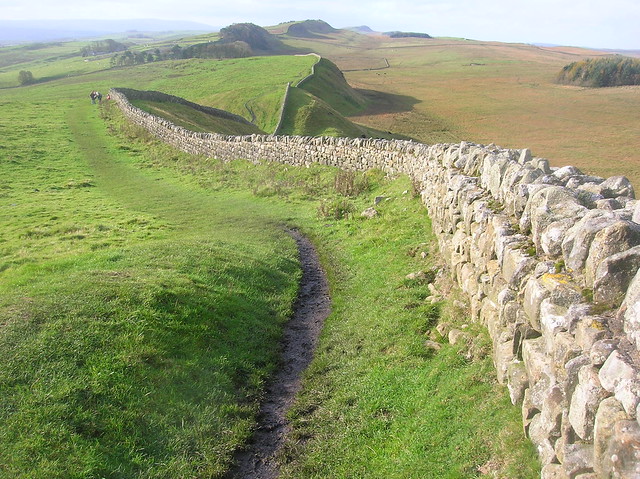
Hadrian's Wall - Wall Mile 54
Hadrian's Wall stretches from the east to west coast of England and was an important frontier of the Roman Empire. Building of the wall began in AD 122 and took six years to complete it’s 84 mile (80 Roman mile) length. Soldiers were garrisoned along the line of the wall in large forts, smaller milecastles, and intervening turrets. The Vallum, a large ditch with mounds on either side, ran along the south side of the wall, protecting the rear of the frontier. Hadrian's Wall was designated as a World Heritage Site in 1987.
Wall mile 54 was originally a turf wall, later replaced by stone. From Milecastle 49 to the western end of Hadrian's Wall on the Solway Firth, the wall was originally constructed from turf, possibly due to the absence of limestone. Subsequently, the turf wall was demolished and replaced with a stone wall.
Wall Mile 54:
- Milecastle 54 (Randylands) - no visible remains, except for some indistinct earthworks
- Turret 54a (Garthside) - no visible surface remains
- Turret 54b (Howgill) - no visible surface remains
Scheduled Monument (#1010997): Hadrian's Wall and vallum between Banks Green Cottage and the road to Lanercost at Banks and the road to Garthside in wall miles 52, 53 and 54
Click the headings below to expand (selected extracts from the Historic England scheduling)
%
Hadrian's Wall survives as a buried feature throughout most of this section overlain in parts by the modern road, fields given to pasture, gardens and field walls. A few remains are visible above ground including the well preserved section of Wall at Hare Hill. Here the core of the Wall is original but part of the face has been reconstructed. It stands to a maximum height of 3.6m and is 2.3m wide. It is consolidated and in the care of the Secretary of State. West of Burtholme Beck there is a length of mortared wall core which stands 1.7m high. Further west there is a shorter stretch of wall core on the same hedge line, 1.3m high. To the east of turret 54a the Wall survives as a substantial turf covered bank at the base of a mature hedge.
The wall ditch survives intermittently as an earthwork in this section. It is best preserved between Hare Hill and Haytongate where it averages 2m deep throughout. It has a maximum depth of 3.2m in parts. Elsewhere the ditch averages 1.8m where extant, but otherwise lies buried below the turf cover or is visible as a slight depression. The ditch upcast mound, usually referred to as the glacis, survives in places to the north of the ditch as an amorphous low mound.
Milecastle 54 is situated on a west facing slope overlooking the Burtholme Beck 230m to the west. It survives as a slight turf covered platform with its remains buried below the surface. Excavations in 1933-4 by Simpson and Richmond showed that the milecastle measured 23.8m north to south by 19.85m across. The western barrack block comprised two rooms, one fitted with stone benches, a hearth and millstone. Below the stone milecastle were found remains of the earlier turf milecastle built in beaten clay.
Turret 54a is situated on an east facing slope overlooking Burtholme Beck to the east. It survives as a buried feature below the turf cover with no remains visible above ground. It was located and excavated in 1933 by Simpson who found that there were two independent turrets one behind the other. The excavations showed that the earlier Turf Wall turret had partly collapsed into the wall ditch, and so the decision had been taken to construct a new free- standing turret, also of Turf Wall type, immediately to the south. The Turf Wall and its ditch were reconstructed slightly to the north of the former line. Later, when the Turf Wall was replaced in stone, the new Stone Wall was connected to the second turret, thus leaving a short length where the lines of the Turf and Stone walls diverge.
The exact course of the Roman road known as the Military Way, which ran along the corridor between the Wall and vallum linking turrets, milecastles and forts, is not yet confirmed in this section. The only traces visible on the ground are two stretches of a low slight swelling, one west of milecastle 54 and the other about 200m east of turret 53b. Elsewhere it survives as a buried feature with no remains visible above ground.
The vallum survives as an earthwork visible on the ground throughout most of this section. The ditch averages between 1.6m and 2m deep where extant. Elsewhere it is silted up and is overlain by the turf cover. The north mound averages between 0.3m and 0.9m high and the south mound 0.3m and 1.3m high. The vallum was trenched in two places on Hare Hill, first in 1894 and again in 1903 by Haverfield. The north and south mounds were found together with the marginal mounds. The supposed Roman camp shown to the immediate south of the vallum in Abbey Park Wood is no longer identified as Roman.
Scheduled Monument (#1010982): Hadrian's Wall between the road to Garthside and The Centurion Inn, Walton, in wall miles 54 and 55
Click the headings below to expand (selected extracts from the Historic England scheduling)
%
Hadrian's Wall survives as a buried feature throughout this section with few traces visible on the ground. Between Howgill and turret 55a the Wall survives as a substantial turf covered bank, up to 1.4m high, which is surmounted by a fence and hedge. West of Dovecote Bridge a section of Wall 20m long stands to an average height of 1m. It is now covered by a protective mound of earth, and it is in the care of the Secretary of State. Between this section of Wall and Walton the Wall was trenched in 13 places by Haverfield in 1902. The Wall was found to be substantially robbed along its course. Its line here is visible on the ground as an intermittent slight rise in grassland. Elsewhere in this section the Wall survives as a buried feature with no remains visible above ground except for the occasional rise seen in a hedgeline.
The wall ditch survives as a feature visible on the ground as a slight depression, averaging 0.5m deep, throughout most of this section. It is best preserved to the east of turret 55a where it is 2.4m deep. The ditch upcast mound, usually referred to as the glacis, which lies to the north of the ditch has been ploughed out in this section. The only visible remains of this feature are to the east of turret 55a where it survives as a slight mound.
Turret 54b is situated about 150m north east of Howgill House. It survives as a buried feature with no remains visible above ground. It was located by Simpson in 1933 who considered it to be of the original Turf Wall series.
The exact course of the Roman road known as the Military Way, which ran along the corridor between the Wall and the vallum linking turrets, milecastles and forts, has not been confirmed in this section. However, it is expected to be situated parallel to the Wall about 20m-30m south of it.
Scheduled Monument (#1010983): The vallum between the road to Garthside and the track east of Castlesteads in wall miles 54, 55 and 56
Click the headings below to expand (selected extracts from the Historic England scheduling)
%
The vallum survives as buried feature throughout most of this section. It is best preserved to the west of Low Wall where the ditch is visible as a slight depression which deepens as it descends to the stream. Otherwise the only surface traces are slight rises and dips in hedgelines where they cross the ploughed down mounds and ditch of the vallum. Elsewhere the vallum mounds have been reduced by ploughing leaving no trace above ground. Similarly the vallum ditch has been entirely silted up leaving no obvious remains on the surface.
Where there are no surface traces the course of the vallum is known from excavations by Haverfield during 1900-1901. His trenches revealed the course of the vallum west of Howgill farm and to the south of Walton. About 30m east of the track to the east of Castlesteads, Haverfield's excavation in 1901 showed that there was a major realignment in the course of the vallum here. This sharp southward turn was made to encompass the Roman fort at Castlesteads within the military corridor between the Wall and vallum.




from https://historicengland.org.u…
Hadrian's Wall between the road to Garthside and The Centurion Inn, Walton, in wall miles 54 and 55 - List Entry
- ...The monument includes the section of Hadrian's Wall and its associated features between the west side of the road to Garthside in the east and the Centurion Inn at Walton …
Added by
Simon Cotterill
from https://historicengland.org.u…
The vallum between the road to Garthside and the track east of Castlesteads in wall miles 54, 55 and 56 - List Entry
- ...The monument includes the section of vallum and its associated features between the road to Garthside in the east and the track to the east of Castlesteads in the west. …
Added by
Simon Cotterill
from https://historicengland.org.u…
Hadrian's Wall and vallum between Banks Green Cottage and the road to Lanercost at Banks and the road to Garthside in wall miles 52, 53 and 54 - List Entry
- ....The monument includes the section of Hadrian's Wall and vallum and their associated features between Banks Green Cottage and the road to Lanercost at Banks in the east and the …
Added by
Simon Cotterill

from https://historicengland.org.u…
Hadrian's Wall between the road to Garthside and The Centurion Inn, Walton, in wall miles 54 and 55 - List Entry
- ...The monument includes the section of Hadrian's Wall and its associated features between the west side of the road to Garthside in the east and the Centurion Inn at Walton …
Added by
Simon Cotterill
from https://historicengland.org.u…
The vallum between the road to Garthside and the track east of Castlesteads in wall miles 54, 55 and 56 - List Entry
- ...The monument includes the section of vallum and its associated features between the road to Garthside in the east and the track to the east of Castlesteads in the west. …
Added by
Simon Cotterill
from https://historicengland.org.u…
Hadrian's Wall and vallum between Banks Green Cottage and the road to Lanercost at Banks and the road to Garthside in wall miles 52, 53 and 54 - List Entry
- ....The monument includes the section of Hadrian's Wall and vallum and their associated features between Banks Green Cottage and the road to Lanercost at Banks in the east and the …
Added by
Simon Cotterill