Topics > Heritage Sites > Hadrian's Wall > Wall Mile 34
Wall Mile 34
Hadrian's Wall - Wall Mile 34
Hadrian's Wall stretches from the east to west coast of England and was an important frontier of the Roman Empire. Building of the wall began in AD 122 and took six years to complete it’s 84 mile (80 Roman mile) length. Soldiers were garrisoned along the line of the wall in large forts, smaller milecastles, and intervening turrets. The Vallum, a large ditch with mounds on either side, ran along the south side of the wall, protecting the rear of the frontier. Hadrian's Wall was designated as a World Heritage Site in 1987.
Wall Mile 34:
- Milecastle 34 (Grindon) - no visible surface remains; site is marked by a distinctive copse of trees.
- Turret 34a (Grindon West) - visible consolidated remains.
- Turret 34b - overlaid by Sewingshields farmhouse (itself built of Roman stone).
Scheduled Monument (#1010963): Hadrian's Wall and vallum between the field boundary at Brown Dikes and the field boundary east of turret 34a in wall miles 32, 33 and 34
Click the headings below to expand (selected extracts from the Historic England scheduling)
Map showing the Scheduled Monument area (Historic England data).
%
Milecastle 34 is located within a small walled plantation about 430m east of turret 34a. It survives as a buried feature beneath the walls of the plantation and the wooded interior. It was noted by the antiquarian Horsley in this location during the 1730s. Milecastle 34 is in the care of the Secretary of State together with the length of wall, wall ditch and vallum to the east, as far as the point where the B6318 road crosses the vallum ditch.
See our page: Milecastle 34 with further details, map, and photos.
Scheduled Monument (#1010964): Hadrian's Wall and associated features between the boundary east of turret 34a and the field boundary west of milecastle 36 in wall miles 34, 35 and 36
Click the headings below to expand (selected extracts from the Historic England scheduling)
Map showing the Scheduled Monument area (Historic England data), with additional markers.
%
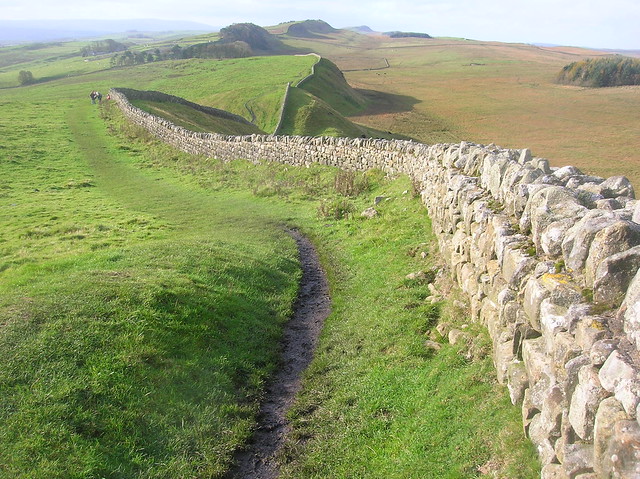
This section of the Wall occupies the crest and slopes along Sewingshields Crags. The upstanding remains of Hadrian's Wall, the milecastle and turrets are Listed Grade I, from turret 34a to turret 35a. The Wall survives intermittently as an upstanding feature throughout this section. West of milecastle 35 the Wall survives as an irregular turf-covered mound, averaging 2.5m wide and 0.6m high. Either side of milecastle 35 the remains of the Wall are upstanding and have been consolidated. At 2.3m wide it is of narrow wall type, though it has been set on a broad wall foundation, 3m wide. It stands to a maximum height of 1.5m. Along the crest of Sewingshields Crags the upstanding sections of consolidated Wall are divided by sections of the Wall which survive as turf-covered mounds, averaging 2.5m wide and 1m high. Where the Wall changes direction to a north-south alignment it survives as a buried feature beneath a modern field wall made from reused Roman masonry. This field wall overlies the north face of the Wall. The nearly 3km of Wall around Sewing Shields farm is in the care of the Secretary of State.
For most of this section there is no outer ditch, as the Wall occupies the crest of the steep outcropping bedrock of Sewingshields Crags and a rock cut ditch would have been superfluous. At Busy Gap a section of ditch was cut which survives as a feature, 12m wide and up to 1.2m deep. West of milecastle 36 another shorter section of ditch was cut, now measuring 2.1m in depth and 10m in width. To the north of the Wall, at the foot of Kings Hill crags is a narrow linear earthwork, up to 7m wide which has been identified as a prehistoric field boundary.
The well preserved remains of turret 34a, which are in the care of the Secretary of State, are located on an east facing slope. It was located in 1912 by Simpson and was partly excavated during 1947 and 1958. The site was again excavated during 1971 for the Department of the Environment and was shown to measure 3.55m north-south by 3.9m east-west. It had a door in the east side and a possible ladder platform in the south west corner. It has narrow walls measuring 0.95m wide.
Most of the pottery recovered from the turret is of second century AD date. In the medieval period the turret walls were partly reduced and the south face of Hadrian's Wall was continued across the turret to make a continuous rampart walk. Medieval pottery sherds, were also found which suggests that the rampart walk was possibly in use at the same time as Sewingshields Castle, which lies about 150m to the north west.
See our page: Turret 34a for further information and photos.
The exact location of turret 34b is not known with certainty as there are no surviving upstanding remains. On the basis of the usual spacing, the turret would be expected to be located beneath the Sewing Shields farm complex
The course of the Roman road known as the Military Way, which ran along the corridor between the Wall and the vallum linking turrets, milecastles and forts survives as a turf-covered linear mound throughout most of this section. It is visible as a disturbed causeway averaging 5m wide with traces of a stone revetment on the south side. It was partly excavated between 1978 and 1980 when it was shown to have a damaged metalled surface 4m wide, a stone revetment on the south scarp, and to have been overlain by later roadways. Branch roads survive linking the Military Way with the south gates of both milecastles 35 and 36. At milecastle 35 the low, uneven turf-covered mound of the causeway is up to 5.5m wide and 0.2m high.
Scheduled Monument (#1010965): The vallum and early Roman road between the field boundary east of turret 34a and the field boundary west of milecastle 36 in wall miles 34, 35 and 36
Click the headings below to expand (selected extracts from the Historic England scheduling)
%
The vallum survives as a series of upstanding earthworks throughout this section. The north mound of the vallum has been reduced by pasture improvement, though it still averages 1m in height. A number of low points in the mound throughout its course denote crossings over the vallum. The south mound averages about 1.2m in height, but in places it is overlain and partly obliterated by a modern field wall. The vallum ditch is well preserved, averaging 2m in depth.
The causeway of an early Roman road is located running parallel to the vallum on its north side opposite Moss Kennels. It is visible as a turf-covered mound....
Listed Buildfing, Grade I (#1045249): Hadrian's wall, Milecastles and Turrets
Includes Hadrian's wall; milecastles 30, 31, 34 and 35; turrets 29B, 30A, 30B, 33B, 34A and 35A.
Roman sites nearby:
- Temporary Roman camp at Seldom Seen, by Stanegate (Roman Road) - buried remains, about 1½ mile south of the Wall




from https://historicengland.org.u…
HADRIANS WALL, MILCASTLES AND TURRETS - List Entry
- "Hadrian's wall; milecastles 30, 31, 34 and 35; turrets 29B, 30A, 30B, 33B, 34A and 35A. AD 122, reconstructed AD 205. Rubble core with dressed stone faces. Course of wall …
Added by
Simon Cotterill
from https://historicengland.org.u…
Hadrian's Wall and associated features between the boundary east of turret 34a and the field boundary west of milecastle 36 in wall miles 34, 35 and 36
- ....The monument includes the section of Hadrian's Wall and its associated features between the field boundary east of turret 34a in the east and the field boundary west of milecastle …
Added by
Simon Cotterill
from https://historicengland.org.u…
The vallum and early Roman road between the field boundary east of turret 34a and the field boundary west of milecastle 36 in wall miles 34, 35 and 36 - List Entry
- ....The vallum and its associated features including the Roman road between the field boundary east of turret 34a and the field boundary west of milecastle 36 survive well as a …
Added by
Simon Cotterill
from https://historicengland.org.u…
Hadrian's Wall and vallum between the field boundary at Brown Dikes and the field boundary east of turret 34a in wall miles 32, 33 and 34 - List Entry
- ....The monument includes the section of Hadrian's Wall, vallum and their associated features between the field boundary at Brown Dikes in the east and the field boundary east of turret …
Added by
Simon Cotterill

from https://historicengland.org.u…
HADRIANS WALL, MILCASTLES AND TURRETS - List Entry
- "Hadrian's wall; milecastles 30, 31, 34 and 35; turrets 29B, 30A, 30B, 33B, 34A and 35A. AD 122, reconstructed AD 205. Rubble core with dressed stone faces. Course of wall …
Added by
Simon Cotterill
from https://historicengland.org.u…
Hadrian's Wall and associated features between the boundary east of turret 34a and the field boundary west of milecastle 36 in wall miles 34, 35 and 36
- ....The monument includes the section of Hadrian's Wall and its associated features between the field boundary east of turret 34a in the east and the field boundary west of milecastle …
Added by
Simon Cotterill
from https://historicengland.org.u…
The vallum and early Roman road between the field boundary east of turret 34a and the field boundary west of milecastle 36 in wall miles 34, 35 and 36 - List Entry
- ....The vallum and its associated features including the Roman road between the field boundary east of turret 34a and the field boundary west of milecastle 36 survive well as a …
Added by
Simon Cotterill
from https://historicengland.org.u…
Hadrian's Wall and vallum between the field boundary at Brown Dikes and the field boundary east of turret 34a in wall miles 32, 33 and 34 - List Entry
- ....The monument includes the section of Hadrian's Wall, vallum and their associated features between the field boundary at Brown Dikes in the east and the field boundary east of turret …
Added by
Simon Cotterill