Topics > Tyne and Wear > Gateshead > Lamesley > Ravensworth Castle > Ravensworth quadrangular castle
Ravensworth quadrangular castle
Scheduled Monument area - based on Historic England data (Open Government Licence).
Scheduled Monument (#1016975): Ravensworth quadrangular castle
Click the headings below to expand (selected extracts from the Historic England scheduling)
With other types of castle, they are major medieval monument types which, belonging to the highest levels of society, frequently acted as major administrative centres and formed the foci for developing settlement patterns. Castles generally provide an emotive and evocative link to the past and can provide a valuable educational resource, both with respect to medieval warfare and defence, and to wider aspects of medieval society. All examples retaining significant remains of medieval date are considered to be of national importance.
Though altered the surviving remains of the medieval fortified house and the 18th century country house will provide information on the form and evolution of the site known as Ravensworth Castle. The 19th century country house, although not included in the scheduling, continues the story of development on the site into the 19th and 20th centuries.
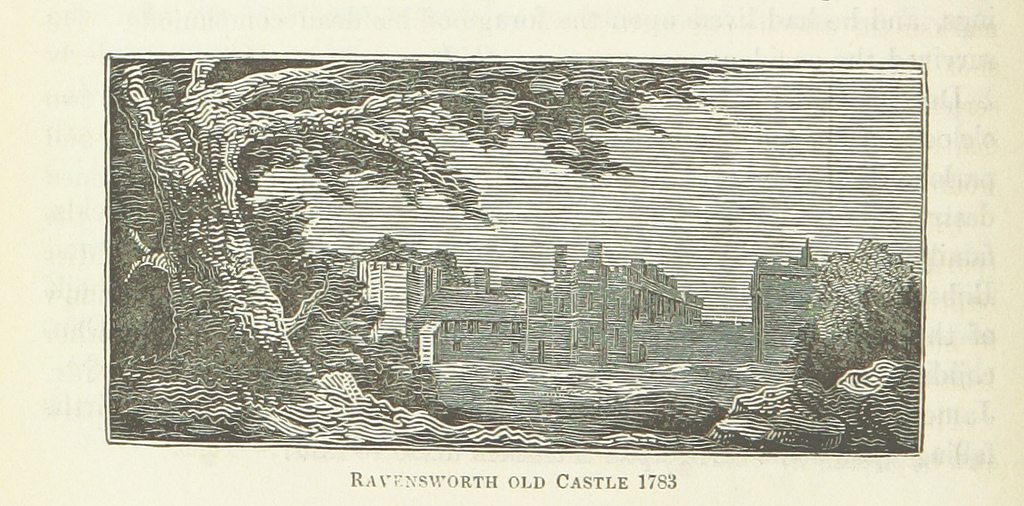
The monument includes the medieval remains of Ravensworth Castle, which is situated in woodland 600m south east of Trench Hall. There are three phases to the castle; a medieval quadrangular castle, an 18th century country house, and a 19th century country house. The monument includes the remains of the medieval fortified house and the below ground remains of the 18th century country house built within the area of the medieval castle. The 19th century country house, Listed Grade II*, and stable block, Listed Grade II, are not included in the scheduling. The medieval fortified house, the standing remains of which are Listed Grade II*, was built in the style of a quadrangular castle, which is a typical form of the 14th century. The remains include two corner towers, sections of curtain walling and deposits preserved beneath the present ground surface. The two surviving corner towers are in the north east and south east corners of the quadrangle. Both stand to 10m high, almost their full original height, although the crenellation of both towers is now absent. They are of roughly coursed sandstone construction quoined with ashlar. The quoins of the south tower (between 0.5 and 1m wide) are wider than those of the north tower, (approximately 0.25m wide) and the north tower is only quoined above a chamfered string course at first floor level. The south tower is also larger (8.5m by 6m) than the north tower (7.5m by 6m). The north tower has a brick vaulted basement level entered and lit from an opening in the west wall. A doorway in the south wall gives access to a stair leading up to the principal chamber of the tower. An additional stair, immediately inside the doorway, leads up the south wall to the roof and also provides access to the top of the east curtain wall. The principal chamber has a pointed vault supported on a chamfered string, a fireplace in the north wall, a window in the east wall, a recessed shelf in the south wall and access to a garderobe which extends along the south side of the chamber. A doorway in the west wall, which provided access to the curtain wall, is partially blocked to form a round headed window. The south tower has a basement level entered via an opening in the west wall. A small room is immediately on the left of the entrance and is lit by a window in the west wall. The principal chamber is entered through an internally rebated doorway. It has a slab vault, a blocked window in the east wall and a fireplace in the south wall. A narrow chamber is accessed from the principal chamber and runs the length of the north wall. A doorway in the north wall of the tower gives access via a stair along the west wall to the upper levels of the tower. It is lit by a four-light window at first floor level in the west wall. The principal chamber of the first floor has a slab vault, an inserted window in the west wall and a firepalce in the south wall. This room gives access to a small chamber built into the south curtain wall and a long narrow chamber running the length of the north wall with a stone sink at its western end. The principal chamber of the second floor has a rounded vault carried on a roll moulded string course. The chamber has a projecting fireplace in the north wall, a window in the east wall, and a recessed shelf and blocked window in the south wall. The south wall also gives access to a garderobe in the south west corner. The stair gives access to a mezzanine level and the roof. Sections of curtain wall survive attached to the towers. These are of roughly coursed rubble construction, 1.5m wide, and standing up to 4m high. The two surviving sections of the east curtain extend approximately 7m out from each of the surviving corner towers. The section attached to the north tower decreases in height by a series of steps; this was first depicted in 1728 on an illustration by Nathaniel and Samuel Buck. The section attached to the south tower also decreases in height with distance from the tower, although the stepped profile depicted in the 1728 illustration has been altered by a stair leading onto the wall from the first floor of the north tower. The surviving section of the south curtain wall extends west from the south tower for 7m and is of two parts. The first 3m from the tower is of roughly coursed rubble construction and has a splayed window at ground level, and above this a room contained within the wall which is accessed from the first floor of the south tower. The south curtain wall has been extended with well-coursed ashlar. The 18th century country house was erected within the medieval quadrangle in 1724 and altered and improved under the advice of James Paine (the architect who also designed nearby Gibside chapel) by 1759. It was demolished prior to the erection of the second house in 1808. No identifiable remains of it are visible, although remains will be preserved beneath the present ground surface. Plans of this house prior to the alterations of the mid-18th century show features of the medieval period incorporated into its fabric. The second house was built between 1808 and 1846. The main house lay immediately west of the medieval castle but some of its service buildings and yards overlay the medieval centre or, in the case of the stable block, stand to its east. The majority of the house was demolished in 1953. Two parts of the 19th century house are within the medieval quadrangle: a gateway and the remains of service buildings. The Tudor arch gateway is flanked on either side by a 4m long, 4m high wall terminating at a 7m high round turret. It is of coursed ashlar sandstone and the crenellations, which only survive above the gateway, extended along the walls and on the turrets. The surviving remains of the service buildings are constructed of a mixture of roughly coursed rubble and brick. The gateway and service block within the area of the medieval centre are included in the scheduling as they may retain medieval fabric within their structures. The first reference to the place name of Ravensworth occurs in AD 1080 in association with Bishop Flambard. It was granted to the bishop's nephew, Richard Fitz-Marmaduke in whose family it remained until the 14th century. The castle then passed by marriage to the Lumleys, who retained it until the latter part of the 15th century. In 1489 it passed by marriage to Sir Henry Boynton of Sedbury and similarly in 1530 it passed to Sir Henry Gascoigne. In 1607 the castle was bought by Sir Thomas Lidell, in whose family it remained until 1976.

from https://historicengland.org.u…
Ravensworth quadrangular castle - Scheduling
- A quadrangular castle is a strongly fortified residence built of stone, or sometimes brick, around a square or rectangular courtyard. The outer walls formed a defensive line, frequently with towers …
Added by
Simon Cotterill

from https://historicengland.org.u…
Ravensworth quadrangular castle - Scheduling
- A quadrangular castle is a strongly fortified residence built of stone, or sometimes brick, around a square or rectangular courtyard. The outer walls formed a defensive line, frequently with towers …
Added by
Simon Cotterill