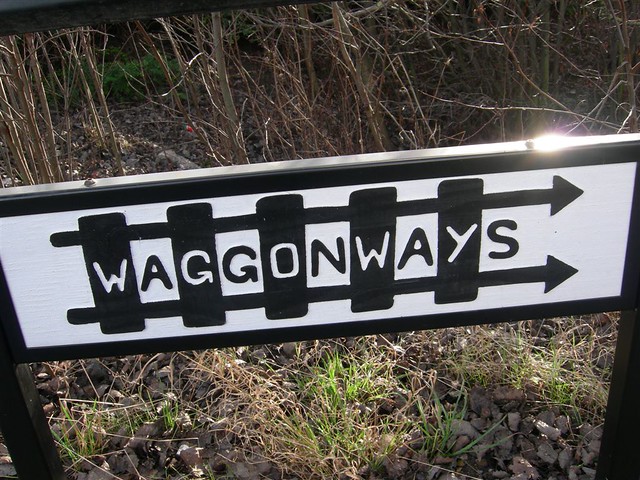
Topics > Tyne and Wear > Gateshead > Dunston > Coal working and waggon way at Dunston Hill
Coal working and waggon way at Dunston Hill
Scheduled Monument area - based on Historic England data (Open Government Licence).
On the north side of Dunston Hill are the remains of coal workings and an early waggon way, noted as being a good example of the pre-19th century Tyneside coal industry. Outcrop mining prevailed around the Tyne until the early 17th century, when most of the coal deposits near the surface were becoming exhausted. Then mining transitioned to deeper coal seams, located increasingly inland, requiring waggon ways to transport the coal to the River Tyne.
This site, by Dunstan Hill includes well preserved sections of one of these early waggon ways – the Northbanks-Dunston waggon way. It includes a cutting, which is believed to be one of the best examples of pre-1720 railway engineering. Constructed in 1699, this was the location for the first recorded railway brake-testing. The site also includes the remains of early coal workings. The site is a Scheduled Monument (legally protected).
Scheduled Monument (#1018227): Coal mining remains at Dunston Hill
Click the headings below to expand (selected extracts from the Historic England scheduling)
The mining remains on the north side of Dunston Hill represent a rare opportunity to study the relatively unsophisticated mining technology of the early Tyneside coal industry. Evidence of this form of mining was a once a common feature of both banks of the River Tyne but most of these remains have been modified in more recent times by land reclamation and landscaping. The monument therefore represents a rare and valuable survival of these remains. In addition, the remains of the Northbanks-Dunston waggon way cutting are considered to be the finest example of pre-1720 railway engineering known to survive nationally. The site was also the location for the earliest recorded railway brake-testing experiment.
The monument is situated on the northern slope of Dunston Hill and includes the earthwork and other remains of early coal workings and part of an early waggon way embankment and cutting. In the period preceding the early 17th century, the coal industry of Tyneside was dominated by a small number of powerful estates and private cartels. In later centuries most of the royalties at Dunston Hill were divided between powerful coal owning families.
Within the monument, the outcrop of the Main coal seam marks the former boundary of the later Clavering estate. It is believed that several of the larger shafts along this outcrop were sunk by the estate to exploit the deeper Maudlin and Hutton seams. Mining at this time was largely confined to outcropping coal seams, which were generally free-draining and easily worked. These remains are represented by an irregular band of earthworks, where coal was extracted directly from the surface using very simple methods.
The outcrop of the Main coal seam is known to have been mined on the north side of Dunston Hill by at least the Elizabethan period. A 430m long section of the outcrop which is a rare survival of a once much larger area of outcrop coal mining on both banks of the Tyne, is included within the scheduling. By 1650 the Main seam is known to have been almost exhausted.
Outcrop mining prevailed until the early 17th century when most of these deposits were becoming exhausted. At this time mining activity was becoming more reliant on deeper coal seams located increasingly inland, requiring the construction of extensive waggon ways to transport the coal to the River Tyne. The monument includes the best preserved part of one of the early waggon ways including a cutting, which is believed to be one of the finest examples of pre-1720 railway engineering, and a section of waggon way embankment. The cutting was the location for the first recorded railway brake-testing following its construction in 1699.

from https://historicengland.org.u…
Coal mining remains at Dunston Hill - Scheduling
- Coal has been mined in England since Roman times, and between 8,000 and 10,000 coal industry sites of all dates up to the collieries of post-war nationalisation are estimated to …
Added by
Simon Cotterill
from https://sitelines.newcastle.g…
Northbanks Way
- Northbanks Way was the second waggonway to Dunston. Permission to build a waggonway was obtained by the Hon Charles Montagu in leases dated 1689/90 and confirmed in May 1692. However, …
Added by
Simon Cotterill

from https://historicengland.org.u…
Coal mining remains at Dunston Hill - Scheduling
- Coal has been mined in England since Roman times, and between 8,000 and 10,000 coal industry sites of all dates up to the collieries of post-war nationalisation are estimated to …
Added by
Simon Cotterill
from https://sitelines.newcastle.g…
Northbanks Way
- Northbanks Way was the second waggonway to Dunston. Permission to build a waggonway was obtained by the Hon Charles Montagu in leases dated 1689/90 and confirmed in May 1692. However, …
Added by
Simon Cotterill