Topics > Heritage Sites > Hadrian's Wall > Wall Mile 25
Wall Mile 25
Hadrian's Wall - Wall Mile 25
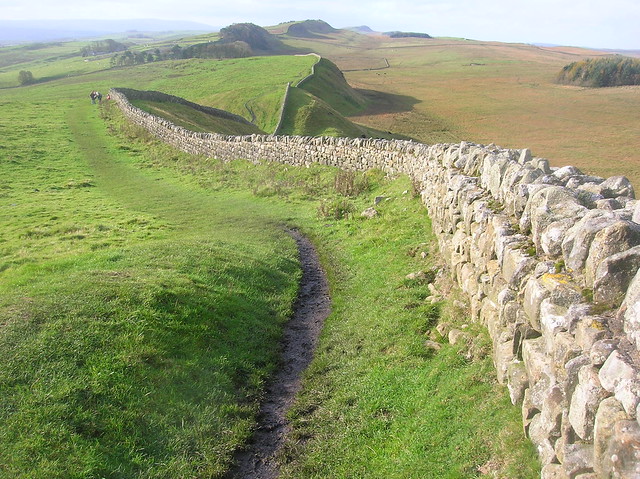
Hadrian's Wall stretches from the east to west coast of England and was an important frontier of the Roman Empire. Building of the wall began in AD 122 and took six years to complete it’s 84 mile (80 Roman mile) length. Soldiers were garrisoned along the line of the wall in large forts, smaller milecastles, and intervening turrets. The Vallum, a large ditch with mounds on either side, ran along the south side of the wall, protecting the rear of the frontier. Hadrian's Wall was designated as a World Heritage Site in 1987.
Wall Mile 25:
- Milecastle 25 (Codlawhill)
- Turret 25a (Hill Head)
- Turret 25b (St Oswald's)
For much of this Wall Mile, the remains of Hadrian's Wall are buried under the B6318 Military Road. However, in places the Wall Ditch can be seen clearly, running just south of the road. Traces of the Military Way and Vallum can also be seen.
Scheduled Monument (#1010958): Hadrian's Wall and vallum between field boundary east of milecastle 24 and field boundary west of the site of turret 25b in wall miles 24 to 25
Click the headings below to expand (selected extracts from the Historic England scheduling)
%
The monument includes the section of Hadrian's Wall and its associated features between the field boundary east of milecastle 24 and the field boundary west of the site of turret 25b east of Brunton Gate. Throughout most of this section there are wide views to the north and south with undulating ground to the east and west restricting the outlook.
The Wall survives as a series of buried remains below the course of the B6318 road throughout most of this section. Where the B6318 road changes direction east of St Oswald's Hill Head Farm the line of the Wall runs below St Oswald's Hill Head Farm itself. Beyond the farm it survives as a turf covered mound 0.5m high, spread by ridge and furrow cultivation.
The wall ditch survives well as an earthwork visible on the ground for most of this section. It averages about 2.5m deep throughout, though it reaches a maximum of 3.6m deep in places. The upcast mound from the ditch, known as the glacis, is visible intermittently, usually in places where it has survived ploughing. Where extant it is generally irregular, sometimes containing much stony material, and averaging about 1m in height.
Milecastle 25 is also situated on a west facing slope with views to the north and south. It survives as a turf covered platform about 1m high. A slight hollow on the south side may indicate an outer ditch. This milecastle was also partly excavated during 1930 by Hepple.
Turret 25a is situated on a west facing slope in the short stretch of ground between the B6318 and St Oswald's Hill Head Farm. It was located by Hepple during 1930, however there are no upstanding remains.
Turret 25b is situated on a west facing slope to the south west of St Oswald's Church. There are no upstanding remains but it will survive as a buried feature, below the line of the east-west field boundary to the west of St Oswald's Church. It too was located and part excavated during 1930 by Hepple. The turret was again partly excavated during 1959 and there was no pottery recovered later than the second century AD.
The course of the Roman road known as the Military Way, which ran along the corridor between the Wall and the vallum linking turrets, milecastles and forts, is known for most of this section. It uses the north mound of the vallum as its base, certainly up to milecastle 25, along which it could be seen by Horsley who recorded it in his 1732 publication. A recent survey by the Royal Commission on the Historical Monuments of England shows that the Military Way probably continued along the north mound of the vallum beyond milecastle 25 where Horsley could no longer trace it.
The vallum survives as an upstanding earthwork for much of this section where it mirrors closely the line of the Wall. The north mound averages about 1m where extant with a maximum height of 1.6m in places. The south mound also averages about 1m, but has a maximum height of 4m in places. The ditch is generally between 1.5m and 2m in depth where extant. Elsewhere it survives as a buried feature that has silted up.




from https://historicengland.org.u…
Hadrian's Wall and vallum between St Oswald's Cottages, east of Brunton Gate and the North Tyne in wall miles 25, 26 and 27 - List Entry
- ".....The monument includes the stretch of Hadrian's Wall, vallum and associated features between St Oswald's Cottages, east of Brunton Gate in the east and the River North Tyne in the …
Added by
Simon Cotterill
from https://historicengland.org.u…
Hadrian's Wall and vallum between field boundary east of milecastle 24 and field boundary west of the site of turret 25b in wall miles 24 to 25 - List Entry
- .....Hadrian's Wall and vallum and their associated works between the field boundary east of milecastle 24 and the field boundary west of the site of turret 25b survive well as …
Added by
Simon Cotterill

from https://historicengland.org.u…
Hadrian's Wall and vallum between St Oswald's Cottages, east of Brunton Gate and the North Tyne in wall miles 25, 26 and 27 - List Entry
- ".....The monument includes the stretch of Hadrian's Wall, vallum and associated features between St Oswald's Cottages, east of Brunton Gate in the east and the River North Tyne in the …
Added by
Simon Cotterill
from https://historicengland.org.u…
Hadrian's Wall and vallum between field boundary east of milecastle 24 and field boundary west of the site of turret 25b in wall miles 24 to 25 - List Entry
- .....Hadrian's Wall and vallum and their associated works between the field boundary east of milecastle 24 and the field boundary west of the site of turret 25b survive well as …
Added by
Simon Cotterill