Topics > Heritage Sites > Hadrian's Wall > Wall Mile 21
Wall Mile 21
Hadrian's Wall - Wall Mile 21
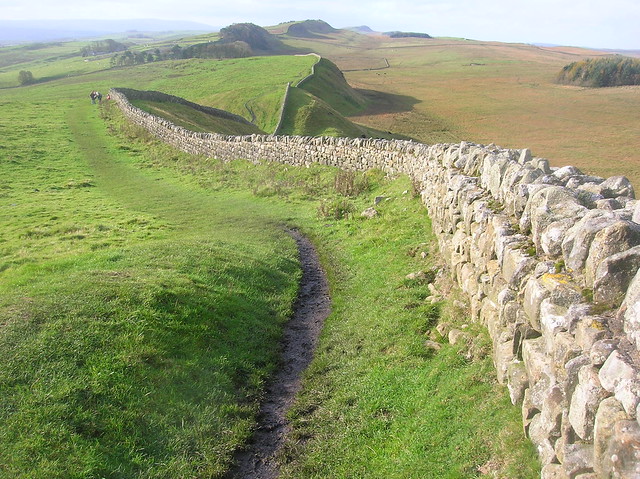
Hadrian's Wall stretches from the east to west coast of England and was an important frontier of the Roman Empire. Building of the wall began in AD 122 and took six years to complete it’s 84 mile (80 Roman mile) length. Soldiers were garrisoned along the line of the wall in large forts, smaller milecastles, and intervening turrets. The Vallum, a large ditch with mounds on either side, ran along the south side of the wall, protecting the rear of the frontier. Hadrian's Wall was designated as a World Heritage Site in 1987.
Wall Mile 21:
- Milecastle 21 (Down Hill) - exact location unconfirmed
- Turret 21A (Red House) - buried under the B6318 road, near Halton Red House (a farm building here includes Roman stone)
- Turret 21B (Fence Burn) - probably buried under the B6318 road
- Haltonchesters Roman fort (Onnum) - visible as a turf covered platform, near the entrance to Halton Castle
Scheduled Monument (#1010623): Hadrian's Wall and vallum between Sunnybrae at Halton Shields and Haltonchesters Roman fort in wall miles 20 and 21
Click the headings below to expand (selected extracts from the Historic England scheduling)
%
The monument includes the section of Hadrian's Wall, vallum and associated features between Sunnybrae at Halton Shields in the east and the field boundary to the immediate east of Haltonchesters Roman fort in the west. This section of the corridor follows an east-west ridge with slopes down to the north and south. Hadrian's Wall survives as a buried feature beneath the B6318 road throughout most of this section.
Hadrian's Wall survives as a buried feature beneath the B6318 road throughout most of this section. At Halton Shields the alignment of the Wall suggests that it runs below the houses and gardens, however, as there are no upstanding remains there, this area is not included in the scheduling. At Down Hill the Wall survives as a discontinuous bank of rubble, 3m wide and 0.4m high, within dense woodland. Quarrying has mutilated much of the east end of this bank.
As with the Wall the wall ditch is in part overlain by the B6318, but in Down Hill Wood it is visible intermittently in the dense woodland up to a maximum of 3m deep. However, it too has been destroyed by quarrying in places. Elsewhere the ditch is traceable as an earthwork in the fields to the north of the B6318.
Milecastle 21 has not yet been located, however on the basis of the usual spacing it would be expected to lie in the vicinity of Halton Red House.
Turret 21a was also located by Hepple in 1935, 75m east of Haltonchesters fort. As with turret 20b it survives as a buried feature below the B6318 road.
The course of the Roman road known as the Military Way, which ran along the corridor between the Wall and vallum linking the turrets, milecastles and forts, survives intermittently throughout this section of the corridor. An excavation undertaken in 1893 revealed that it occupies the north berm of the vallum until the vallum swings south to the east of Down Hill where it resumes a course between the Wall and vallum. There are no upstanding remains west of Down Hill in this section.
The vallum runs parallel with the Wall to Down Hill where it takes a dog-leg to avoid the bedrock close to the surface. It is visible intermittently throughout this section of the corridor. It is best preserved to the south of Down Hill where the vallum ditch has a maximum depth of 2.7m and the north and south mounds reach a height of 1.5m and 1m respectively. Clear traces of crossings survive which are best preserved in the north mound.
Scheduled Monument (#1010624): Haltonchesters Roman fort, settlement and Hadrian's Wall and vallum between the field boundary east of Haltonchesters fort and the Fence Burn in wall mile 21
Click the headings below to expand (selected extracts from the Historic England scheduling)
%
The Roman fort at Haltonchesters, its associated civil settlement and the adjacent section of Hadrian's Wall survive well as upstanding turf covered remains. The fort is unique in having an `L'-shaped plan and as such it is of particular interest. The site has produced significant finds including tombstones, altars and a gold signet-ring. Significant information on the development of the frontier system as well as wider social and economic developments over time will be preserved. The silted ditches will contain environmental evidence which will allow the character of the surrounding area in the Roman period to be better understood.
The fort, known to the Romans as `Onnum', occupies the crest on the east bank of the Fence Burn astride the line of Hadrian's Wall. From the fort there are extensive views to the north where the ground rises gently, and southwards to the Tyne valley. To the west there are views along the course of the wall for 2km, whereas to the east the visibility is restricted by Down Hill 800m away. The fort survives as a turf covered platform up to 1.1m high in places.
A number of surveys and excavations of the fort have been undertaken, the most recent being the survey by the Royal Commission on the Historical Monuments of England during 1989. All the surviving remains of the fort are buried below ground level. A unique feature of the fort is the western extension in the south half of the fort, which has been dated to the Severan period (third century AD). An excavation in 1959 revealed that the west wall of the original Hadrianic fort was demolished to the south of Hadrian's Wall when the fort was extended to the west. The fort enclosed an area of about 1.75ha in its early phase; increasing to 2ha after its extension. Excavations have shown that the fort was probably defended by two outer ditches in its Hadrianic phase and that these were replaced by a single more massive ditch in the later Severan phase. Aerial photographs and parchmarks show the location of a number of internal buildings and roads, as well as parts of the fort walls. The fort was probably initially garrisoned by a cohort of 500 men, part mounted, however in the Severan period it held an ala or cavalry wing of 500 men.
The civil settlement outside the fort, known as the vicus, was located in the field to the south and south east of the fort. There are the remains of two buildings visible above ground, located in the only part of the field devoid of later ridge and furrow. The building to the east is 4.5m wide and at least 12m long. The less well preserved building to the west was also about 4.5m wide, but of indeterminate length. To the SSE of these buildings is a circular stone-lined well, 1.6m in diameter.
The course of the Roman road known as the Military Way, which ran along the length of the corridor between the Wall and the vallum linking turrets, milecastles and forts, survives as a buried feature. It was identified by the presence of parchmarks 300m west of the fort aligned with the postulated gateway to the Severan extension to the fort. To the east the road was also identified by parchmarks within 20m of the fort, aligned with the west gateway.
The course of the Wall on both the east and west sides of the fort lies beneath the B6318 road. Excavation on the west side showed that the junction of the Wall with the fort was on the south side of the west gateway. Excavation in the fort interior located the wall ditch, thus demonstrating that the Wall was built before the erection of Haltonchesters fort.
The vallum survives as a buried feature. Aerial photographs show the ditch of the vallum as a cropmark to the west of the fort, ascending the hill from Fence Burn and fading about 20m from the south west angle of the Severan extension. The vallum ditch on the east side of the fort is visible as a depression in the line of the field boundary 50m to the east of the fort. Its course south of the fort has not yet been confirmed.
Remains of surface quarrying are evident on the hill to the east of the fort. Here sandstone lies close to the surface and outcrops in places providing a ready source of building stone. These quarries survive as hollows and fissures in the area of Carr Crags and on Down Hill. These quarries probably have Roman origins but are likely to have been reworked in the 18th century.
Scheduled Monument (#1010625): Hadrian's Wall and vallum between the Fence Burn and the track to Portgate Cottage in wall miles 21 and 22
Click the headings below to expand (selected extracts from the Historic England scheduling)
%
The monument includes the section of Hadrian's Wall between the Fence Burn in the east and the west side of the track to Portgate Cottage in the west. This section of the Wall occupies an east facing slope with limited views in all directions. The Wall survives as a buried feature below the B6318 road for most of this section.
The Wall survives as a buried feature below the B6318 road for most of this section. The stretch of Wall 220m east to 320m west of the course of the A68, where the B6318 swings north to a roundabout, lies below the 18th century metalled road which is now disused. The wall ditch survives as a buried feature for most of this section; however, towards the west end of the section it survives as a visible earthwork. The maximum height of its south scarp is 4m and the maximum height of its north scarp is 2m. There are slight traces of the upcast mound, known as the `glacis', to the north of the ditch.
Turret 21b occupies a prominent point 230m west of the Roman fort at Haltonchesters. There are no visible remains above ground, but it is expected to survive as a buried feature.
The course of the Roman road known as the Military Way, which ran along the corridor between the Wall and the vallum linking the turrets, milecastles and forts, survives intermittently throughout this section. East of milecastle 22 there is a 170m stretch of the road which survives as an upstanding ridge, in a field which also has extensive ridge and furrow earthworks. The road here survives to a maximum height of 0.3m. Further west its remains were traced as parchmarks in the soil during dry conditions. Elsewhere in this section its course has not yet been confirmed.
The vallum survives intermittently as an upstanding earthwork throughout this section. Where it is best preserved, between the Fence Burn and the A68, the ditch reaches a maximum depth of 0.9m, the north mound a height of 0.7m and the south mound a height of 0.3m. Elsewhere the mounds have been damaged and spread by ridge and furrow cultivation and the ditch has silted up to varying degrees.
The Roman road known as Dere Street which ran from York into Scotland crossed the line of the Wall in this section. The course of the A68 road follows that of Dere Street along this part of its course. Immediately south of the vallum, for 150m, there is an overgrown mound beside the west verge of the A68, representing part of the Roman road which was not built directly over.
An excavation in 1966 revealed that where Dere Street crossed the Wall, a gatehouse, formed of massive masonry blocks which projected northwards from the Wall by 3.6m had been constructed. The site of the gateway lies within the protected area.




from https://historicengland.org.u…
Hadrian's Wall and vallum between Sunnybrae at Halton Shields and Haltonchesters Roman fort in wall miles 20 and 21
- ....Hadrian's Wall and vallum and their associated features between Sunnybrae at Halton Shields and the field boundary to the east of Haltonchesters Roman fort survive as a series of buried …
Added by
Simon Cotterill
from https://historicengland.org.u…
Hadrian's Wall and vallum between the Fence Burn and the track to Portgate Cottage in wall miles 21 and 22 - List Entry
- ....Hadrian's Wall and its associated features between the Fence Burn and the track to Portgate Cottage survive as a series of buried and upstanding remains. Significant information on the development …
Added by
Simon Cotterill
from https://historicengland.org.u…
Haltonchesters Roman fort, settlement and Hadrian's Wall and vallum between the field boundary east of Haltonchesters fort and the Fence Burn in wall mile 21 - List Entry
- ....The Roman fort at Haltonchesters, its associated civil settlement and the adjacent section of Hadrian's Wall survive well as upstanding turf covered remains. The fort is unique in having an …
Added by
Simon Cotterill



from https://historicengland.org.u…
Hadrian's Wall and vallum between Sunnybrae at Halton Shields and Haltonchesters Roman fort in wall miles 20 and 21
- ....Hadrian's Wall and vallum and their associated features between Sunnybrae at Halton Shields and the field boundary to the east of Haltonchesters Roman fort survive as a series of buried …
Added by
Simon Cotterill
from https://historicengland.org.u…
Hadrian's Wall and vallum between the Fence Burn and the track to Portgate Cottage in wall miles 21 and 22 - List Entry
- ....Hadrian's Wall and its associated features between the Fence Burn and the track to Portgate Cottage survive as a series of buried and upstanding remains. Significant information on the development …
Added by
Simon Cotterill
from https://historicengland.org.u…
Haltonchesters Roman fort, settlement and Hadrian's Wall and vallum between the field boundary east of Haltonchesters fort and the Fence Burn in wall mile 21 - List Entry
- ....The Roman fort at Haltonchesters, its associated civil settlement and the adjacent section of Hadrian's Wall survive well as upstanding turf covered remains. The fort is unique in having an …
Added by
Simon Cotterill