Topics > Heritage Sites > Hadrian's Wall > Wall Mile 18
Wall Mile 18
Hadrian's Wall - Wall Mile 18
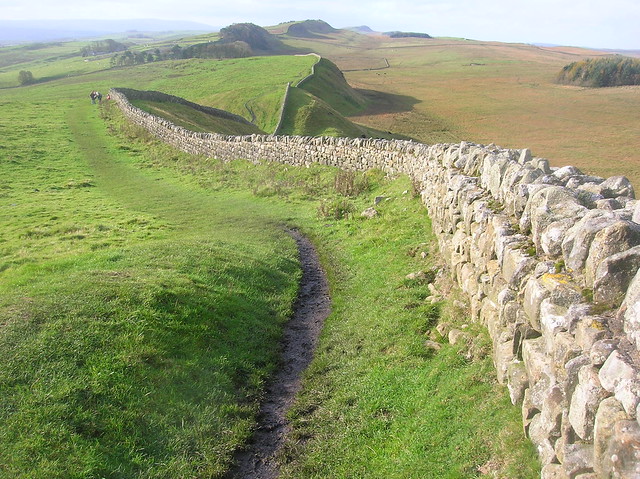
Hadrian's Wall stretches from the east to west coast of England and was an important frontier of the Roman Empire. Building of the wall began in AD 122 and took six years to complete it’s 84 mile (80 Roman mile) length. Soldiers were garrisoned along the line of the wall in large forts, smaller milecastles, and intervening turrets. The Vallum, a large ditch with mounds on either side, ran along the south side of the wall, protecting the rear of the frontier. Hadrian's Wall was designated as a World Heritage Site in 1987.
Wall Mile 18:
- Milecastle 18 (East Wallhouses)
- Turret 18a (Wallhouses East)
- Turret 18b (Wallhouses West)
Scheduled Monument (#1010622): Hadrian's Wall and vallum between the B6309 and the B6321 in wall miles 16, 17 and 18
Click the headings below to expand (selected extracts from the Historic England scheduling)
The monument includes the section of Hadrian's Wall, vallum and associated features between the B6309 in the east and the B6321 in the west. The ground slopes gently upwards towards the west throughout this section of the monument. There are wide views to the north, east and south. However, the rising ground to the west restricts the outlook in this direction.
Hadrian's Wall survives as buried remains below the road surface of the B6318 road thoughout the length of this section.
The wall ditch survives as an earthwork to the north of the road for most of the length of this section. It averages about 1.4m deep throughout, though it reaches a maximum of 3m in places.
Milecastle 18 occupies a position on a gentle west facing slope on the south side of the B6318 road at East Wallhouses. There are no visible remains above ground; however, its site is known as it was partly excavated in 1931 when its walls were found to be almost 2.5m thick.
Turret 18a is located at the junction of the minor road to West Moorhouses off the B6318 on an east facing slope. There are no visible remains apart from a rise in the hedgeline. Part excavation in 1931 showed that the surviving buried remains are very well preserved. Its ladder platform stood to its full height with six stone steps.
Turret 18b is located 50m to the east of Welton Burn on an east facing slope. There are no visible remains. It was partly excavated in 1959 when animal bones and pottery were found.
The course of the Roman road, known as the Military Way, linking turrets, milecastles and forts, which ran along the corridor between the Wall and the vallum, is not yet confirmed in this section. It is known to exist here as Horsley noted in the 1730s that it ran along the north mound of the vallum for a short distance where the Wall and vallum are very close and then, `A little after it has passed by the Wall houses, it runs almost parallel both to the Wall and the north agger'. Its remains now survive as buried features.
The vallum continues on the same straight alignment as its neighbouring sections throughout its course. It is visible as an upstanding earthwork except for the first kilometre west of the Northern Reservoir where it has been reduced by cultivation and its ditches silted up. The north mound averages about 0.25m in height whereas the south mound averages about 0.6m high. The vallum ditch averages about 0.8m in depth, though it reaches a depth of 1.4m in places.
Scheduled Monument (#1017534): Hadrian's Wall and vallum between the B6321 and Sunnybrae at Halton Shields, in wall miles 18 and 19
Click the headings below to expand (selected extracts from the Historic England scheduling)
Hadrian's Wall, vallum and their associated features between the B6321 and Sunnybrae at Halton Shields, survive as a series of buried and upstanding remains. Significant information on the function of the remains and the development of the frontier system over time will be preserved. This section of the corridor occupies an east facing slope for most of its length with views to the north and east, but more restricted outlooks to the south and west.
The Wall survives as a buried feature below the surface of the B6318 road.
The wall ditch survives as an extant earthwork to the north of the road throughout this section except where it is overlain by access crossings. The average depth of the ditch is about 1.5m; however it reaches a maximum depth of 3m in places. For most of its length the ditch has a width of 12m. An open drain runs along the base of the ditch eastwards from East Wallhouses for 500m.
The vallum runs straight throughout this section on the same alignment as its neighbouring sections. It survives as an upstanding earthwork in varying states of preservation throughout the length of this section. The north and south mounds reach a maximum height of 0.8m while the ditch has a maximum depth of 0.6m.




from https://historicengland.org.u…
Hadrian's Wall and vallum between the B6321 and Sunnybrae at Halton Shields, in wall miles 18 and 19
- ....The monument includes the section of Hadrian's Wall, vallum and their associated features between the B6321 in the east and Sunnybrae at Halton Shields in the west. This section of …
Added by
Simon Cotterill
from https://historicengland.org.u…
Hadrian's Wall and vallum between the B6309 and the B6321 in wall miles 16, 17 and 18 - List Entry
- ...Hadrian's Wall and its associated features between the B6309 and the B6321 survive as a series of buried and upstanding remains. Significant information on the function of the remains and …
Added by
Simon Cotterill

from https://historicengland.org.u…
Hadrian's Wall and vallum between the B6321 and Sunnybrae at Halton Shields, in wall miles 18 and 19
- ....The monument includes the section of Hadrian's Wall, vallum and their associated features between the B6321 in the east and Sunnybrae at Halton Shields in the west. This section of …
Added by
Simon Cotterill
from https://historicengland.org.u…
Hadrian's Wall and vallum between the B6309 and the B6321 in wall miles 16, 17 and 18 - List Entry
- ...Hadrian's Wall and its associated features between the B6309 and the B6321 survive as a series of buried and upstanding remains. Significant information on the function of the remains and …
Added by
Simon Cotterill