Topics > Heritage Sites > Hadrian's Wall > Wall Mile 16
Wall Mile 16
Hadrian's Wall - Wall Mile 16
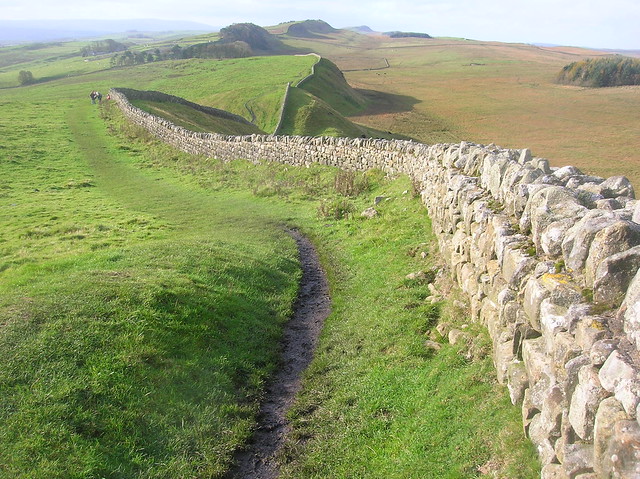
Hadrian's Wall stretches from the east to west coast of England and was an important frontier of the Roman Empire. Building of the wall began in AD 122 and took six years to complete it’s 84 mile (80 Roman mile) length. Soldiers were garrisoned along the line of the wall in large forts, smaller milecastles, and intervening turrets. The Vallum, a large ditch with mounds on either side, ran along the south side of the wall, protecting the rear of the frontier. Hadrian's Wall was designated as a World Heritage Site in 1987.
Wall Mile 16:
- Milecastle 16 (Harlow Hill)
- Turret 16a
- Turret 16b
Scheduled Monument (#1010618): Hadrian's Wall and vallum between the March Burn and Oatens Bank, Harlow Hill in wall miles 13,14 and 15
Click the headings below to expand (selected extracts from the Historic England scheduling)
The monument includes Hadrian's Wall and vallum and associated features between the March Burn in the east and the west side of Oatens Bank, Harlow Hill the west. This section of the Wall runs gently downhill from the March Burn to milecastle 15 before running up a steep gradient to the summit of Harlow Hill. The Wall commands wide views to the north and south along this section, but the undulating terrain to the east and west means that views are restricted in these directions. Hadrian's Wall aims for the high points throughout this section which includes the summits of Eppies Hill and Harlow Hill, unlike the vallum which takes a lower course skirting to the south of Harlow Hill. The Wall survives beneath the B6318 road throughout the whole length of this section.
For more detail on this section see pages: Wall Mile 14 and Wall Mile 15
Milecastle 16 is situated on the crest of Harlow Hill with wide views in all directions. It survives as a buried feature in the field to the south of the road. The only upstanding feature is the scarp on the east side of the reduced platform. The milecastle was excavated by Hepple and Richmond in the 1950s.
Scheduled Monument (#1010620): Hadrian's Wall from Oatens Bank, Harlow Hill, to Whittle Dene Watercourse in wall mile 16
Click the headings below to expand (selected extracts from the Historic England scheduling)
The monument includes the section of Hadrian's Wall and its associated features between Oatens Bank, Harlow Hill, in the east and Whittle Dene Watercourse in the west. This section of Wall runs downslope towards the west from Harlow Hill. There is gently rising ground to the north, whereas to the south the ground slopes away.
The Wall survives as a buried feature beneath the B6318 road throughout this section.
The external ditch on the north side of the Wall is silted up for most of this section although traces of its north scarp are still visible about 200m west of Harlow Hill.
The exact location of turrets 16a and 16b has not yet been confirmed.
The exact location of turrets 16a and 16b has not yet been confirmed.
The course of the Roman road known as the Military Way, linking turrets, milecastles and forts, which ran along the corridor between the Wall and the vallum, is not yet confirmed in this section of the corridor. However, during the 1730s Horsley noted its existence a little west of Harlow Hill describing it as `about thirteen foot' in width.
Scheduled Monument (#1010621): The vallum between Oatens Bank, Harlow Hill, and Whittle Dene Watercourse in wall mile 16
Click the headings below to expand (selected extracts from the Historic England scheduling)
The monument includes the vallum and its associated features between Oatens Bank, Harlow Hill, in the east and Whittle Dene Watercourse (part of the Northern Reservoir) in the west. It follows a straight course along the south side of Harlow Hill and survives as a series of buried features. Its course can be determined by the slight undulations in the arable land which denote the banks and ditches. The banks have been ploughed flat.
Scheduled Monument (1010622): Hadrian's Wall and vallum between the B6309 and the B6321 in wall miles 16, 17 and 18
Click the headings below to expand (selected extracts from the Historic England scheduling)
The monument includes the section of Hadrian's Wall, vallum and associated features between the B6309 in the east and the B6321 in the west. The ground slopes gently upwards towards the west throughout this section of the monument. There are wide views to the north, east and south. However, the rising ground to the west restricts the outlook in this direction.
For more details on this section see pages: Wall Mile 17 and Wall Mile 18




from https://historicengland.org.u…
Hadrian's Wall and vallum between the B6309 and the B6321 in wall miles 16, 17 and 18 - List Entry
- ...Hadrian's Wall and its associated features between the B6309 and the B6321 survive as a series of buried and upstanding remains. Significant information on the function of the remains and …
Added by
Simon Cotterill
from https://historicengland.org.u…
Hadrian's Wall from Oatens Bank, Harlow Hill, to Whittle Dene Watercourse in wall mile 16 - List Entry
- ....Hadrian's Wall and its associated features from Oatens Bank to Whittle Dene Watercourse survive well as a series of buried remains. Significant information on the development of the frontier system …
Added by
Simon Cotterill
from https://historicengland.org.u…
The vallum between Oatens Bank, Harlow Hill, and Whittle Dene Watercourse in wall mile 16 - List Entry
- ....The vallum and its associated features between Oatens Bank, Harlow Hill, and the Whittle Dene Watercourse survive well as a series of buried remains. Significant information on the development of …
Added by
Simon Cotterill

from https://historicengland.org.u…
Hadrian's Wall and vallum between the B6309 and the B6321 in wall miles 16, 17 and 18 - List Entry
- ...Hadrian's Wall and its associated features between the B6309 and the B6321 survive as a series of buried and upstanding remains. Significant information on the function of the remains and …
Added by
Simon Cotterill
from https://historicengland.org.u…
Hadrian's Wall from Oatens Bank, Harlow Hill, to Whittle Dene Watercourse in wall mile 16 - List Entry
- ....Hadrian's Wall and its associated features from Oatens Bank to Whittle Dene Watercourse survive well as a series of buried remains. Significant information on the development of the frontier system …
Added by
Simon Cotterill
from https://historicengland.org.u…
The vallum between Oatens Bank, Harlow Hill, and Whittle Dene Watercourse in wall mile 16 - List Entry
- ....The vallum and its associated features between Oatens Bank, Harlow Hill, and the Whittle Dene Watercourse survive well as a series of buried remains. Significant information on the development of …
Added by
Simon Cotterill