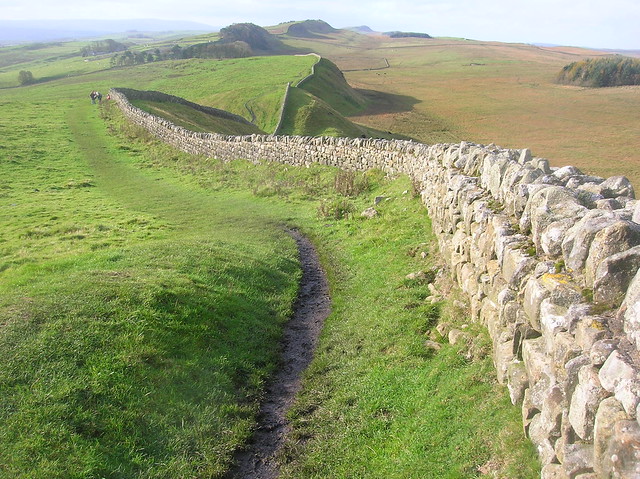
Topics > Heritage Sites > Hadrian's Wall > Aesica (Great Chesters fort) > Roman aqueduct to Great Chesters from Caw Burn
Roman aqueduct to Great Chesters from Caw Burn
Scheduled Monument areas - based on Historic England data (Open Government Licence).
The Romans constructed an extensive aqueduct to carry water from Caw Burn westwards to supply Great Chesters Roman fort (Aesica). It took a meandering route, closely following the topography of the landscape. The aqueduct is preserved as a partial earthwork and in other locations as a cropmark. The Scheduled Monument (legally protected) includes five separate sections, which stretch over approximately 8.7 km of the aqueduct’s length.
Scheduled Monument (#1003788): Roman aqueduct to Great Chesters from the Cawburn
Click the headings below to expand (selected extracts from the Historic England scheduling)
By the end of the 2nd century, most forts and also public towns had been provided with aqueducts, the need for water being driven particularly by the construction of elaborate bath houses, and the developing fashion of bathing as a social activity amongst both the military and civilian populations. Aqueducts were used throughout the Roman period, and some were still functioning into the 5th century AD. They were found throughout Roman Britain with particular concentrations along Hadrian's Wall. Only 60 have now been identified to survive. As a rare monument type which provides an important insight into Roman engineering skills and both military and civilian life, all surviving examples are identified to be nationally important.
The monument includes the remains of an aqueduct of Roman date, which carried water from Caw Burn westwards to Great Chesters Roman fort. The aqueduct adopts a circuitous route closely following the topography of the landscape. The protected portions of the monument are contained within five separate areas of protection, which stretch over approximately 8.68km of the aqueduct’s length. The aqueduct is preserved as a partial earthwork and in other locations as a cropmark.