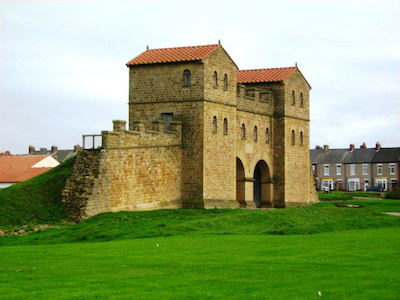
The Granaries, about AD 160, Arbeia Roman Fort & Museum



-
Description
The remains are part of the granary building built sometime during the construction of the first fort in about AD 160. It was used for storing grain and other food stuffs. Unlike the granaries built later, this early granary was made from white limestone. The grain was kept fresh and dry by storing it on a raised wooden floor which rested on square masonry supports that run in rows down the building. The granary was demolished in about AD 300 and replaced by two kilns for making roof tiles. Although one of the kilns is protected under the grass mound you can still see the supports which held up the firing floor of the other kiln. A clay of turf chamber would have been constructed above the floor onto which the tiles waiting to be fired would have been placed. Usually there would have been a pit dug at one end to stoke the fire which would heat the chamber but in this case no evidence of one has been found. This is the only tile kiln visible in Roman Britain but it may not have been used. -
Owner
Following Hadrian -
Source
Flickr (Flickr) -
License
What does this mean? CC BY-SA 2.0
-
Further information
Link: https://www.flickr.com/photos/41523983@N08/6782632835/
Resource type: Image
Added by: Pat Thomson
Last modified: 2 months, 2 weeks ago
Viewed: 46 times
Picture Taken: 2011-07-31T16:21:40 -
Co-Curate tags