Topics > Civil Parishes in Cumbria > Tebay Civil Parish, Penrith > Low Borrowbridge Roman Fort
Low Borrowbridge Roman Fort
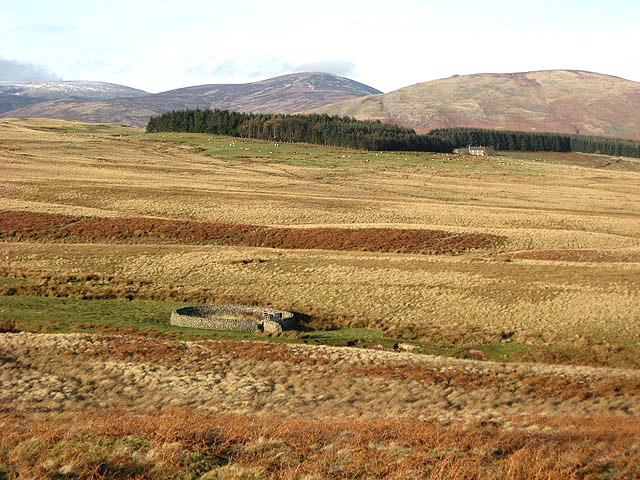
The remains of a Roman fort and its civilian settlement (vicus) are located at Low Borrowbridge, about 2 miles south of Tebay in Cumbria. The site is situated by the confluence of the River Lune and Borrow Beck. Whist there are few visible remains, this is an important archeological site, which is a Scheduled Monument (legal protection).
Scheduled Monument (#1007240): Low Borrowbridge Roman fort
Click the headings below to expand (selected extracts from the Historic England scheduling)
The remains of Low Borrowbridge Roman fort and civilian settlement are extensive and well-preserved. Partial excavation has shown the monument to contain widespread archaeological deposits which provide important information on the date and nature of use of the site. The monument provides important insight into a wide range of aspects of civilian and military life during the Roman occupation of Britain.
The monument includes the remains of a fort and its civilian settlement (or vicus) of Roman date, situated on a spur formed by the River Lune and Borrow Beck and contained within three separate areas of protection. The fort is aligned roughly north-south and is parallelogram-shaped in plan measuring approximately 140m by 105m.
The fort is surrounded by a rampart and multiple ditches which are partially preserved as earthworks. The majority of the rampart stands to a height of 1.5m and is clearly visible on all but the south side. The rampart is mainly visible as an earthen bank but partial excavation has shown the defences to include sandstone, limestone and slate walling, the remains of which survive beneath the turf. On the north side there is a double ditch with traces of a counterscarp whilst on the west and south sides there are double ditches with an average width of 7m and with feint traces of additional ditches, especially in the south west corner. There is no clear earthwork remains of a ditch on the east side, however, there are outworks in the form of a 1m high and 2m wide earthen bank which runs above the River Lune parallel to the east side of the fort at a distance of 50m before turning to join the main ditch system at the north east corner of the fort. The ditches and ramparts on the west side of the fort are interrupted by a 1.8m wide single portal gateway with the stone foundations of the gateway protruding through the turf.
To the south of the fort are the remains of its civilian settlement, which are preserved as cropmarks and below ground archaeological deposits, the most significant of which include a bath house built in two phases and a cemetery, both of which were used during the 2nd to 3rd centuries AD.
Several excavations have demonstrated the significant extent of archaeological remains related to both the fort and its vicus. Excavations in 1950 indicated that the fort was occupied during much of the Roman occupation of Britain with evidence of multiple episodes of destruction and reconstruction. The lower parts of the rampart and wall are understood to be dated to the Hadrianic period whilst the upper parts date to the Severan period.

from https://historicengland.org.u…
Low Borrowbridge Roman fort
- Roman forts served as permanent bases for auxiliary units of the Roman Army. In outline they were straight sided rectangular enclosures with rounded corners, defined by a single rampart of …
Added by
Simon Cotterill

from https://lunesdale.wordpress.c…
Low Borrowbridge Roman Fort
- Low Borrowbridge Roman Fort
The final report for the digs at Low Borrowbridge is available here : Final_Report_Low_Borrowbridge_2011_2012 (1)
Summary of 2014-17 work.
A draft paper summarising all of the …
Added by
Simon Cotterill

from https://historicengland.org.u…
Low Borrowbridge Roman fort
- Roman forts served as permanent bases for auxiliary units of the Roman Army. In outline they were straight sided rectangular enclosures with rounded corners, defined by a single rampart of …
Added by
Simon Cotterill
from https://lunesdale.wordpress.c…
Low Borrowbridge Roman Fort
- Low Borrowbridge Roman Fort
The final report for the digs at Low Borrowbridge is available here : Final_Report_Low_Borrowbridge_2011_2012 (1)
Summary of 2014-17 work.
A draft paper summarising all of the …
Added by
Simon Cotterill