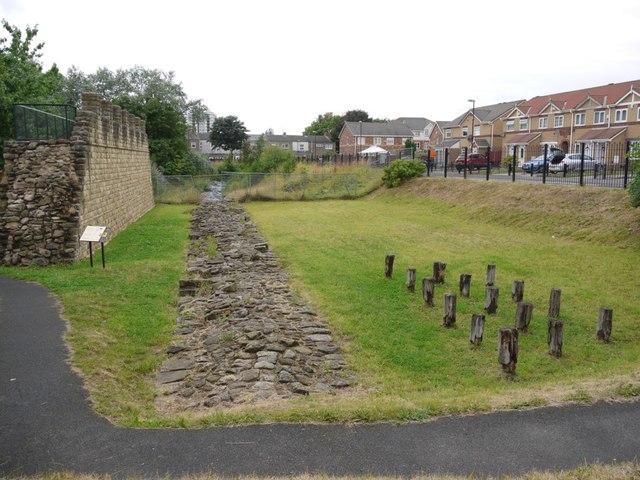
Remains of Hadrian's Wall, off Buddle Street, Wallsend


-
Description
"A reconstruction of the Wall has been built on the left. The stakes on the right were placed in an array of pits found during excavation on the north side of the Wall and may have been additional defences known as 'cippi pits'. Archaeologists have never had proof that the top of the Wall could be walked on, because there is no place where it survives to full height. Since 2000, north of the Wall, between the wall and its ditch, three rows of large post holes have been found at Wallsend, at Shields Road, Byker, and over a 1km length between Throckley and Heddon-on-the-Wall. Rather than being man-traps (lilia) these pits were emplacements for an impenetrable entanglement of forked branches (cippi). Their purpose (described by Julius Caesar) was to slow down attackers and make them vulnerable to projectiles thrown by troops on a defensive rampart, holding up the attack for long enough for reinforcements to arrive. These obstacles would only have been effective if the ditch and berm of Hadrian’s Wall could be commanded from the Wall-top. The discovery of the obstacles supports the view that there was a wall-walk and battlements along the top of Wall from which defenders could fight off attackers. http://www.hadrianswallquest.co.uk/did-you-know" Photo by Andrew Curtis, 2013. -
Owner
Andrew Curtis -
Source
Geograph (Geograph) -
License
What does this mean? Creative Commons License
-
Further information
Link: http://www.geograph.org.uk/photo/3574020
Resource type: Image
Added by: Simon Cotterill
Last modified: 3 months, 1 week ago
Viewed: 80 times
Picture Taken: 2013-07-28 -
Co-Curate tags