Topics > Northumberland > Colwell > Colwell - historical account, 1893
Colwell - historical account, 1893
Extract from: A history of Northumberland. issued under the direction of the Northumberland county history committee, Bateson E. et al., 1893,
COLWELL.
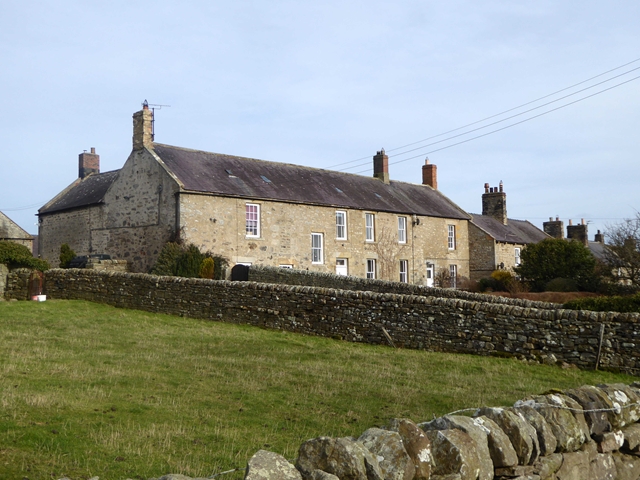
The hamlet of Colwell is about a mile to the east of Great Swinburn, and consists of two lines of houses running east and west, which stand on natural terraces facing each other. On the northern terrace stood the chapel of Colwell, which, as a dependent of Chollerton, was given to the prior and convent of Hexham, by Odinel de Umframvill ; its site was excavated in 1887, by Mr. R. C. Hedley, who has given a careful description of the result in the Proceedings of the Newcastle Society of Antiquaries. The chapel consists of a nave and chancel, the former measuring in the inside 17 feet, and the latter 13 feet 6 inches. The walls were from 2 feet g inches to 3 feet 3 inches thick, and remained at some points to the height of three courses above a chamfered base course, which ran round the structure and was stepped on the north and south nave walls at their east end. The base course was returned into a door opening. Several arch stones were dis- covered, some with a roll moulding worked on one angle, and some with a roll moulding on two angles, portions doubtless of the chancel arch. There were also some widely splayed window jamb stones, together with fragments of grey roofing slates, and a quantity of charred wood and fragments of mediaeval pottery.
In 1479 the prior and convent possessed a tithe barn, which stood to the north-east of the chapel of Cohvell, and was then waste.' In a survey taken in 1536, the corn tithes of Cohvell, worth 40s. a year, were leased to Sir John Widdrington, by an instrument which did not bear the convent seal.' The ornaments of the chapel in 1552 were 'one challes of tene and one vestment of whyt satten, and thirty years later it was destitute, having neither curate nor chapel wardens.' Cohvell chapel is one of the four mentioned in 1650 as being within the parish of Chollerton, and one hundred and twenty years later, under the designation of Swinburn chapel, it was reported as in decay. In papers connected with a suit in the Ecclesiastical Court of Durham about 1744, when some of the owners of the great tithes of the parish of Chollerton disclaimed their liability to repair the chancel of the parish church, the lecturer of Hexham, who possessed the tithes of Colwell, professed that Colwell was a free or parochial chapel, and that though no service was performed there (for it had been destroyed by the Scots army) its roofless walls remained, and that he was readv (if cleared of all liability towards Chollerton) to repair the chancel of the chapel.
In 1240 Colwell was held of the Heron barony by Gilbert de Umframvill at a socage rent of 40s. ; and its possession enabled the Umframvills to join their detached manor of Chollerton with the rest of the baronv of Prudhoe. It was afterwards reckoned to be the tenth part of a knight's fee.' At the Assizes of 1256 a presentment was made that an unknown man had been found in the fields of Colwell torn to pieces by dogs. No suspicion attached to Reginald, the shepherd of Colwell, who was first to discover the remains, but as the townships of Colwell, Swinburn, Chollerton, and Barrasford did not come in proper numbers to the inquest, they were fined.'' In 1288 John de Burgo and Christian his wife received 16 acres of land in Colwell from John Swynburn,' and in 1293 Walter de Cambhou (sheriif 1278) and Isabel his wife settled 4 messuages, 24 bovates of land, and 44s. of rent, with half of the mill, on their issue severallv. For these lands Walter de Cambhou had in 1277 a grant of free warren, and in 1345 they were claimed by Isabel's grand-daughter Emma, the wife of Robert of Coventry.