Topics > Cockermouth > Cockermouth, 1811
Cockermouth, 1811
Selected extracts from: Jollie's Cumberland, Guide & Directory, 1811.
COCKERMOUTH is a market-town standing at the mouth of the river Cocker, where it enters the Derwent, and contains about 2,600 inhabitants. The grounds on each side are high and undulating, with some small patches of wood on their fronts ; but much of those on the south side are green, uncultivated commons.- The vale of Derwent is beautiful, expanding in fine rich holmes.
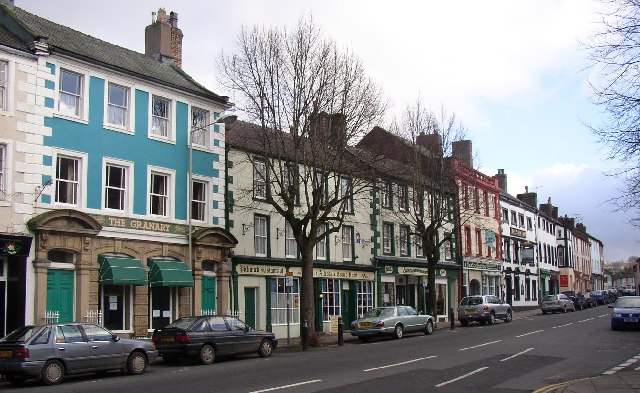
The streets of Cockermouth are spacious, and pretty clean. Here are two principal streets in an angular figure, from the bend of which a short one leads to the castle.
The church and castle are two bold figures in the general appearance of Cockermouth : but the latter is now in ruins, except some apartments at the gate. It stands on a fine eminence at the confluence of the rivers Cocker and Derwent, and has been a fortress of considerable extent and strength. The tower is lofty, and commands an extensive prospect. In exploring these massy remains, we observe, on each side of the gateway leading to the interior court, a dungeon capable of containing 40 or 50 persons each. A small aperture has been left in the crown of the arch , to let down the unhappy wretches who were doomed to the horrid cell ; on the side of each is a slip, or loop hole, whereby the provisions were conveyed with a rope to the miserable captives . Such severities as these, which the prisoners of war suffered in ancient times , certainly rendered their battles more desperate and bloody. This Castle was the baronial seat of the Lords of Allerdale; and is sup- posed to have been built a few years after the Conquest. In the year 1648, being garrisoned by the King, it was reduced by the Parliamentary forces, burnt, or otherwise dismantled, and has laid in ruins ever since . The Earl of Egremont holds his courts of audit in the castle, where he has some apartments fitted up; and he resided here for a short time, last summer.
The only late improvements made in this town worthy of notice is a handsome range of buildings, on the banks of the Cocker, a little above the bridge, the property of Messrs . Stoddart and Son, where an extensive linen-manufactory is carried on. There is also a large thread and cotton-manufactory called the Goat Mills, the property of , and carried on by, Mr. Wm. Fletcher. There is also an extensive manufactory of hats, and another of coarse woollen cloths and shaloons; likewise a pretty considerable trade in tanning and dressing of leather. About a mile up the Cocker, is a paper-mill carried on by Mr. Harden
This is a very ancient borough, and sends two members to Parliament. The first we meet with was in the 2d Edward I.: it discontinued the franchise for several centuries; and the next returns we find to be in the year 1640. The election is by the inhabitants having burgage tenure, who are about 300 ; and the Bailiff of the borough is the returning officer. He is chosen annually at Michaelmas out of the burgesses, by the jury of the leet, which is composed of burgesses , and forms a special jury for the government of the borough. He is head officer within the town, and executes the duty of clerk of the market
In the town is a free school, and a parochial library, containing about 500 choice volumes.